Wire Size Calculator UK: Never Blow a Fuse (or Your Budget) by Guessing Cable Gauges Again
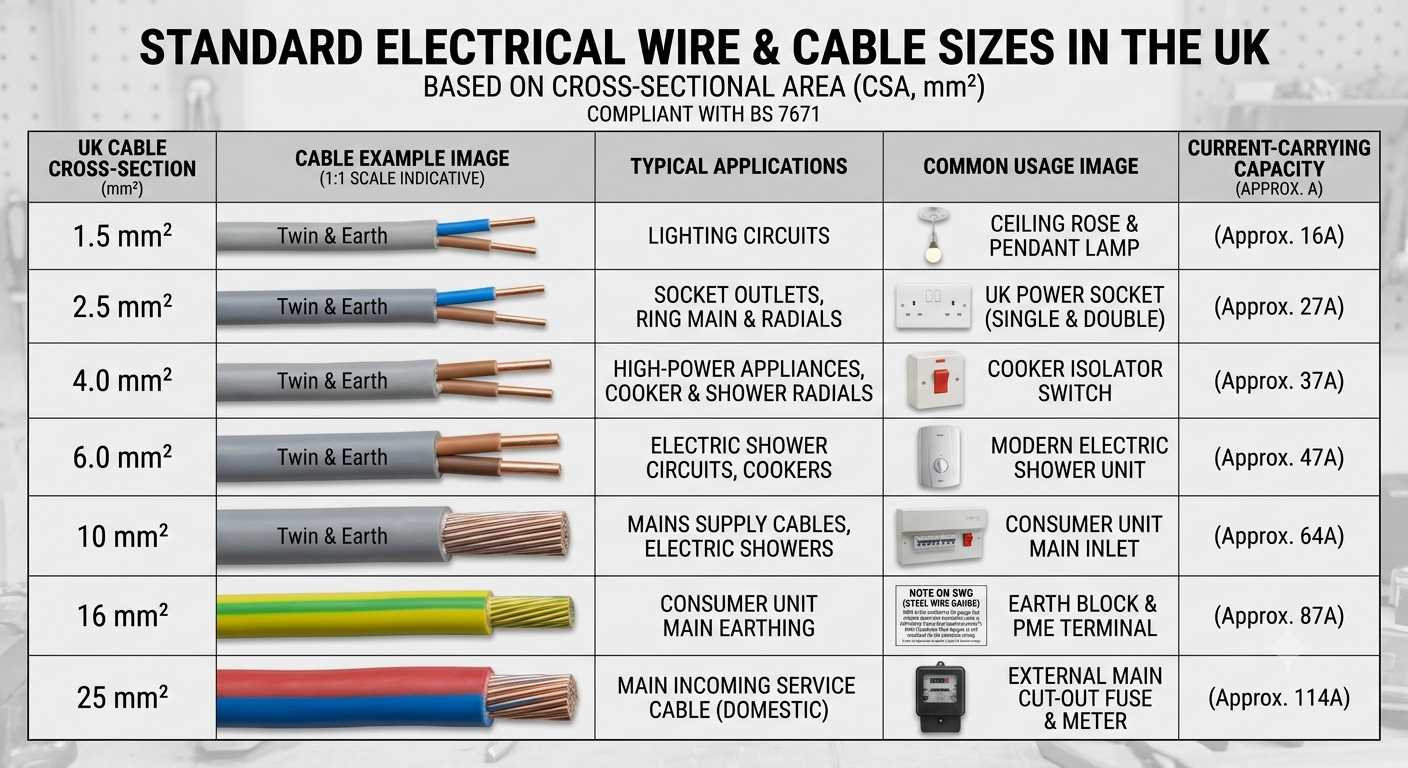
Ever stood in front of the cable rack, scratching your head and wondering if 2.5mm² (14 AWG) will do, or if you need to go up a size? You’re not alone. Sizing electrical cables—whether you call them wires, flex, or cable—can feel like trying to guess the number of screws in a coffee tin. Get it wrong and you’re looking at tripped breakers, melted insulation, or, if you’re really unlucky, a visit from your local fire brigade. Not ideal.
This guide will walk you through how to use a wire size calculator (UK or otherwise), why proper sizing matters, and how to do a quick cable take-off that won’t leave you short (or overpaying for copper you don’t need). We’ll break it down for both metric and imperial folks, with no sparkie jargon and a few cheeky tips from someone who’s made the mistakes so you don’t have to.
Why Getting Cable Size Right Actually Matters
Here’s the bit most people try to skip: wire size is about more than just making the numbers add up. Pick a cable that’s too thin and it’s like trying to push a pint through a straw—you’ll overheat the wire, trip the breaker, or worse. Go too thick, and you’re lugging arm-thick copper around and paying for the privilege. Nobody wins.
Correct sizing keeps your circuits safe, compliant with regs (like the UK’s BS 7671/IEE Wiring Regulations, or the NEC in North America), and saves you money. That’s three reasons right there.
The Basics: What Affects Cable Size?
Bet your merchant never told you this: cable sizing isn’t just about the current. There are four main things to consider:
- Current (Amps): How much juice is flowing through the cable.
- Cable Length: The longer the run, the more resistance (think of running a marathon in wellies versus trainers).
- Installation Method: Clipped direct, in conduit, buried in insulation? Each changes how much heat the cable can lose.
- Voltage Drop: You want your kettle to boil, not just warm up—so don’t let the volts drop too far between the fuse box and the socket.
How Wire Size Calculators Work (UK and Beyond)
Wire size calculators (sometimes called cable size calculators) take the donkey work out of the job. You punch in your current (Amps), length (metres/feet), voltage (230V/120V), and installation details, and out pops the minimum cable size—usually in mm² (square millimetres) for the UK/EU, or AWG (American Wire Gauge) for the US/Canada.
They use formulas like:
Required Cross-Section Area (mm²) = (2 × Length (m) × Current (A) × Resistivity) / (Allowable Voltage Drop (V))
But unless you’re keen on algebra, let the calculator do the lifting. Just remember to check the local regs for your country—don’t rely on US calculators for UK jobs, and vice versa, as the allowed voltage drop and cable types differ.
Worked Example: Sizing Cable for a Ring Circuit
Let’s say you’re wiring sockets (outlets) for a new kitchen in a 10m x 4m (33ft x 13ft) extension. You’re running a ring main (ring circuit), standard in the UK, with a 32A MCB (breaker). The total length of your cable run is 24m (79ft).
You want to know: is 2.5mm² twin & earth (14 AWG) enough, or do you need to go bigger?
Step-by-Step:
- Current: 32A (for the ring circuit).
- Cable Length: 24m (79ft).
- Installation: Clipped direct to a wall (best-case for heat dissipation).
- Voltage Drop Limit: 5% of 230V (for UK), so 11.5V max drop.
Plugging these into a UK cable size calculator (or by checking the tables in the regs):
- 2.5mm² (14 AWG) twin & earth handles up to 27A (clipped direct), but in a ring, each leg shares the load, so you’re good for a 32A breaker.
- Voltage drop for 2.5mm² over 24m at 32A is about 8.6V (well under the 11.5V limit).
Result: 2.5mm² (14 AWG) is spot on. No need to pay for 4mm² (12 AWG) unless you’re running the cable further or through insulation.
| Cable Size | Max Current (Clipped Direct) | Voltage Drop (24m/79ft @ 32A) |
|---|---|---|
| 2.5mm² (14 AWG) | 27A* (see above) | 8.6V |
| 4mm² (12 AWG) | 36A | 5.5V |
*Ring circuits double up, so each leg carries half the current.
How to Measure and Identify Wire Size (UK & US Methods)
Here’s where most DIYers (and a few pros) trip up: not all cables are labelled. If you inherit a bundle of mystery wire, or you’re sorting out an old job, you’ll need to measure it yourself.
Measuring Cable Size (Core Diameter Method)
- Strip the insulation to reveal the copper core.
- Measure the diameter using callipers or a good old ruler (in mm and inches).
- Calculate the area:
- Area = π × (radius)²
- Example: Core diameter is 1.8mm (0.07in), so radius is 0.9mm (0.035in).
- Area = 3.142 × (0.9²) = 2.54mm² (0.0039in²).
- Compare to a cable size chart or the markings.
Note: UK/EU cables are sized by cross-sectional area (mm²), US/Canada by AWG gauge (smaller number = thicker wire).
Identifying by Markings
- UK/EU: Markings like "2.5mm²" or "4.0mm²" printed on the sheath.
- US: Look for “14 AWG”, “12 AWG” etc.
Quick Reference Table
| Core Diameter | UK/EU Size | US Size (AWG) |
|---|---|---|
| 1.8mm (0.07in) | 2.5mm² | 14 AWG |
| 2.3mm (0.09in) | 4mm² | 12 AWG |
| 2.9mm (0.11in) | 6mm² | 10 AWG |
Practical Tips for Ordering Cable
- Always round up: Nobody ever finished a job wishing they’d bought less cable.
- Allow for wastage: Add 10%—the spare teabags of the cable world.
- Check installation method: If you’re running cable through insulation, you may need to go up a size.
- Keep to one unit: Don’t measure your runs in feet and buy cable by the metre—unless you like brain teasers.
Questions People Are Actually Asking
What size wire do I have?
Check the markings on the cable’s sheath—UK cables will say "2.5mm²", "4.0mm²", etc., while US/Canada cables show AWG sizes like "14 AWG". If there’s no marking, measure the diameter of the copper core and use a size chart.
How to measure cable size UK?
Strip the insulation, measure the core diameter in millimetres (or inches), square the radius, multiply by π (3.142), and compare to a cable size chart. Or, just use the markings—if they’re visible.
How to calculate cable size UK?
Use a wire size calculator: enter your current (Amps), cable length (metres/feet), installation method, and voltage. The calculator (or the tables in the regs) will tell you the minimum cross-sectional area (mm²) you need.
How to identify cable size UK?
Look for markings on the cable sheath. If missing, measure the core diameter and check against a chart for the corresponding mm² size.
How to measure thread size UK?
Thread size refers to screws and bolts, not electrical wire. For electrical cable, you want the core diameter, not thread pitch.
How to measure wire gauge UK?
UK cables use mm² (cross-sectional area), not gauge. For gauge, measure the diameter, then use a conversion chart to find the equivalent AWG size if needed.
What size wire for sockets UK?
For standard ring circuits, 2.5mm² (14 AWG) twin & earth is the norm, protected by a 32A breaker. For radial circuits, check the current and length—sometimes 4mm² (12 AWG) is needed for longer runs or heavy loads.
Conclusion
Sizing electrical cable is a bit like buying paint: get it right, and the job’s smooth; get it wrong, and you’re either back to the shop or explaining scorch marks to the customer. Use a wire size calculator or the regs tables, measure twice, and always allow for a bit of slack. Want to take the guesswork out? Try a proper cable size calculator—the next time you’re at the merchant, you’ll know exactly what to order and why.
Free tools to put this into practice
Reading is one thing — working out your own numbers is what saves time and money. Here are the free HowMuchDoINeed calculators that pair best with this guide:
- Understanding Cable Sizes Beginners Guide Uk — work out exactly how much you need and what it will cost.
- Cable Size Calculator — get an instant materials estimate for your project.
- Cable Size Calculator Uk Guide — size up quantities and costs before you head to the merchant.
- Skip Size Calculator — plan your order so you avoid over- or under-buying.
Explore every free calculator on HowMuchDoINeed — no sign-up required.