Cable Size Calculator UK: The No-Nonsense Guide to Getting Your Wiring Right First Time
Pick the wrong cable size and you're either looking at a fire risk or a wallet that's taken an unnecessary hit. Neither's a great outcome. This guide walks you through how to measure, identify, and calculate cable sizes in the UK, when to lean on a cable size calculator, and how to sidestep the mistakes that catch people out. Adding a socket, rewiring a room, or just trying to decode those numbers on the sheath — you're in the right place.
Why Cable Size Matters
Get the cable size wrong and your wiring either can't safely carry the load — which means overheating, voltage drops, and potential fire — or you've bought oversized cable that costs more and takes up space you don't have. Think of it like buying a hosepipe: too narrow and the pressure builds up dangerously, too wide and you've spent money on pipe you didn't need. UK wiring regulations (BS 7671) set out the minimum requirements, so there's no winging it.
What is a Cable Size Calculator?
Ever tried doing the weekly shop with no list and a blindfold? That's roughly what specifying cable without a proper take-off looks like. A cable size calculator is an online tool that works out the right cross-sectional area (in mm²) for your cable, based on the specifics of your job. Feed it the right information and it does the heavy lifting for you.
It takes into account:
- Current (Amps) the circuit will carry
- Length of the cable run
- Voltage (usually 230V in the UK)
- Type of cable (e.g., twin & earth, armoured)
- Installation method (in wall, conduit, clipped direct, etc.)
If you want to quickly find the right cable size for your project, try our Cable Size Calculator for accurate, regulation-compliant results.
How to Measure and Identify Cable Size (UK)
1. Identifying Cable by Markings
Most modern cables have the size printed along the sheath — which is handy, because someone already did the maths for you. Common sizes you'll come across:
- 2.5mm² (twin & earth, commonly used for sockets)
- 1.5mm² (lighting circuits)
- 4mm², 6mm², 10mm² (cookers, showers, or high-load appliances)
2. Measuring Cable Diameter
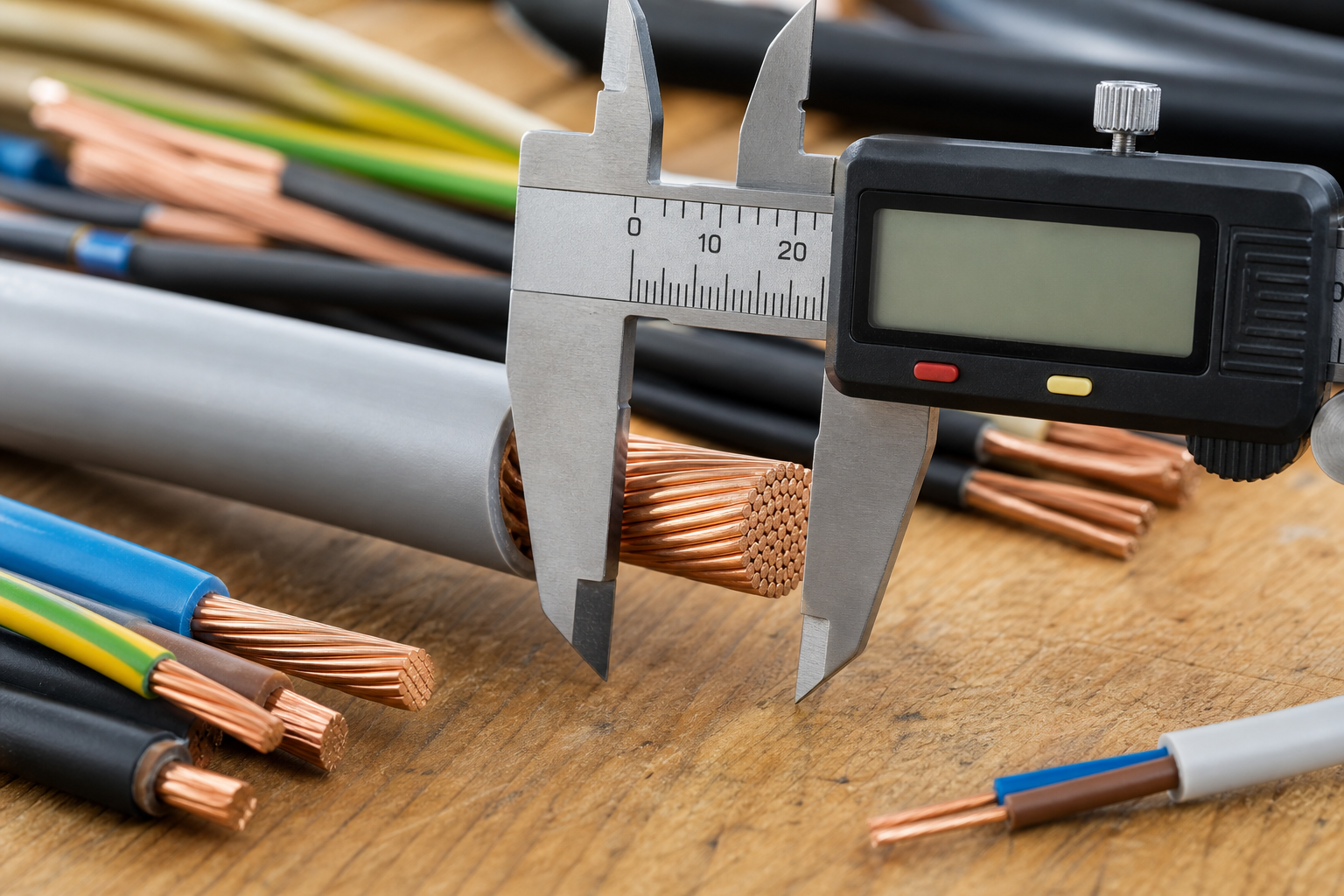
Markings worn off or missing altogether? You'll need to measure the conductor directly. Here's how:
- Strip the insulation (if safe and permitted) to expose the copper core.
- Use a vernier caliper to measure the diameter.
- Calculate cross-sectional area (mm²):
- Formula: Area = π × (diameter ÷ 2)²
Example:
- Measured diameter = 1.78mm
- Area = 3.142 × (1.78 ÷ 2)² = 3.142 × (0.89)² ≈ 3.142 × 0.792 = 2.49mm²
- This matches a standard 2.5mm² cable.
Imperial Conversion
- 1.78mm ≈ 0.070 inches
- Area = π × (0.035)² ≈ 3.142 × 0.001225 = 0.00385 in²
- 2.5mm² ≈ 0.0039 in²
How to Calculate the Correct Cable Size (Step-by-Step)
Doing this by hand isn't impossible, but there are enough variables to trip you up if you're not careful. Here's the basic process:
- Find the maximum current (Amps) your device or circuit will draw
- Measure the cable run (metres or feet)
- Check installation conditions (e.g., in thermal insulation, clipped direct)
- Reference cable manufacturer tables or BS 7671 charts
- Apply correction factors for grouping, temperature, etc.
Worked Example
Let's wire a 32A ring main (socket circuit) with a 20m cable run, clipped direct.
| Parameter | Value |
|---|---|
| Max current (Amps) | 32 |
| Cable run | 20m (65.6 ft) |
| Voltage | 230V |
| Installation | Clipped direct |
- From standard tables, 2.5mm² twin & earth cable (clipped direct) can carry up to 27A — too low for 32A.
- 4mm² can carry up to 36A — suitable for 32A.
Result: Use 4mm² cable for a 32A ring main with a 20m run, clipped direct.
Tip: If unsure, always consult a qualified electrician or use our Cable Size Calculator for peace of mind.
Common UK Cable Sizes (Quick Reference)
Not every job needs a full calculation from scratch. Here's your cheat sheet — like the spare teabags you keep so you're never caught short on a Monday morning.
| Application | Typical Cable Size |
|---|---|
| Lighting circuits | 1.0–1.5mm² |
| Socket circuits (ring) | 2.5mm² |
| Electric shower/oven | 6–10mm² |
| Cooker circuits | 6mm², 10mm² |
Always check your exact requirements and installation conditions.
Questions People Are Actually Asking
How to measure cable size UK?
Expose the conductor and use a vernier caliper or micrometer to measure its diameter. Then calculate the cross-sectional area in mm² using the formula Area = π × (diameter ÷ 2)². Alternatively — and far more quickly — check the printed markings on the cable sheath.
How to calculate cable size UK?
Work out the maximum current (in Amps) for your circuit, measure the cable run, and check the installation method. Use a Cable Size Calculator to account for all the variables and stay compliant with UK wiring regulations, or refer directly to BS 7671 tables if you fancy a light read.
How to identify cable size UK?
Look for size markings printed on the cable sheath (e.g., 2.5mm², 1.5mm²). If they're missing, measure the conductor diameter and calculate the area as described above. You can also compare the cable against a known reference sample.
How to check cable size UK?
Read the sheath markings, measure the conductor, or dig out your installation plans. For confirmation that the size is genuinely suitable for your load and installation conditions, run it through a calculator — it takes about two minutes.
How to measure electrical cable size UK?
Strip a small section of insulation (if safe), measure the copper core diameter with a vernier caliper, and calculate the area in mm². Alternatively, use a Cable Size Calculator if you already know the circuit details.
How to identify electrical cable sizes UK?
Check the printed sheath markings first — that's always the quickest route. If they're not there, measure the diameter of the copper conductor and calculate its cross-sectional area in mm².
How to size a cable?
Nail down the maximum current, cable length, installation method, and environment. Feed those details into a Cable Size Calculator or cross-reference manufacturer and BS 7671 tables to land on the correct cable. It's not glamorous, but it's the job.
What size cable for UK sockets?
For a standard UK socket ring main, 2.5mm² twin & earth cable is the go-to. For long runs or unusual conditions, you may need to step up to 4mm². Always check regulations or run it through a calculator to confirm — don't just guess because it looks about right.
Conclusion
Getting the cable size right is the foundation of safe, efficient electrical work. Factor in the load, the distance, and the installation method — every time, without exception. If there's any doubt, use a Cable Size Calculator or call in a qualified electrician. The right information before you start is worth a lot more than a rewire after something goes wrong.
Free Tools to Put This Into Practice
Reading is one thing — working out your own numbers is what saves time and money. Here are the free HowMuchDoINeed calculators that pair best with this guide:
- Cable Size Calculator — work out exactly how much you need and what it will cost.
- Duct Size Calculator — work out exactly how much you need and what it will cost.
- Breaker Size Calculator — work out exactly how much you need and what it will cost.
Explore every free calculator on HowMuchDoINeed — no sign-up required.