Plasterboard Calculator: The No-Nonsense Way to Stop Guessing Your Sheet Count and Finish On Time
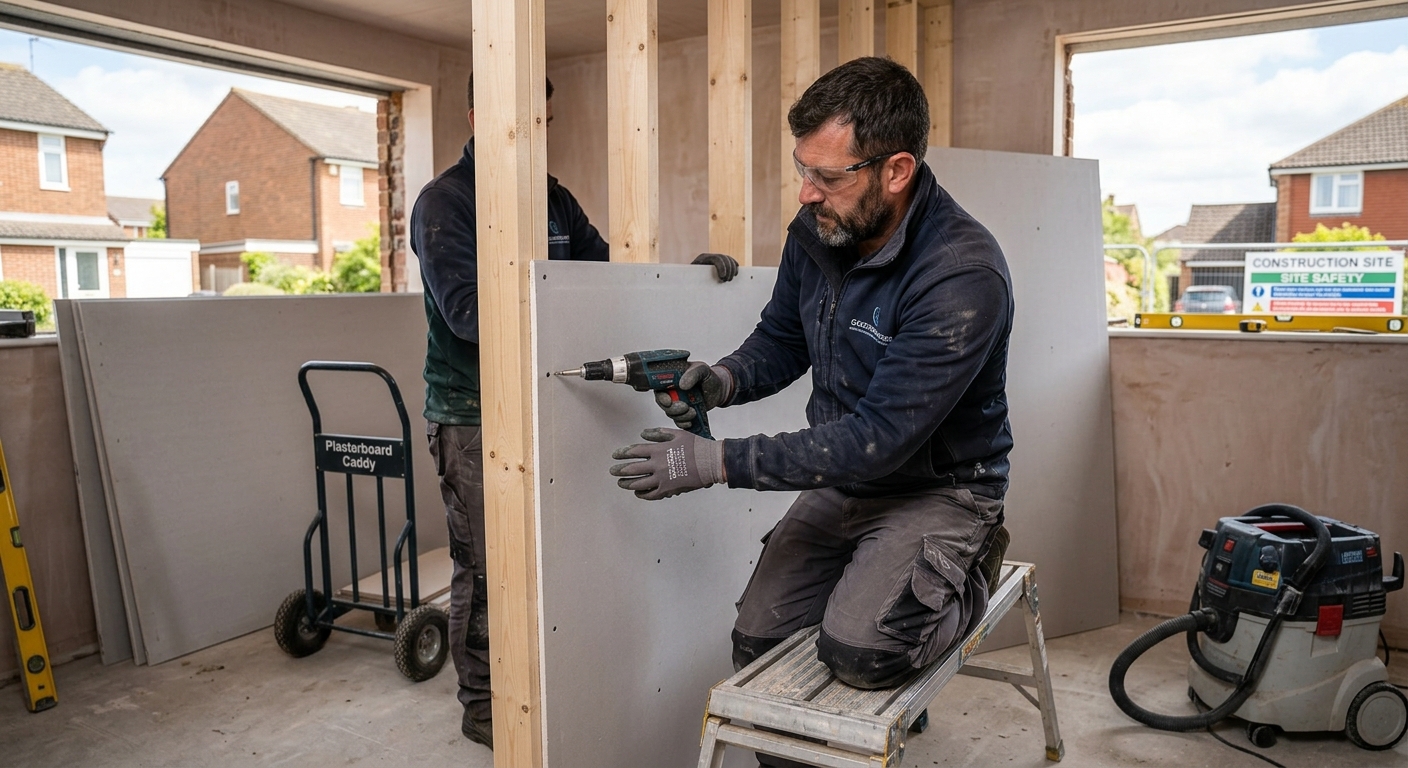
Ever got halfway through boarding a ceiling and realised you’re two sheets short, but the merchant’s just closed for the weekend? Classic. Sorting out how much plasterboard (or drywall, for those across the pond) you actually need shouldn’t feel like a lucky dip. Get the numbers bang on now, and you’ll save yourself a return trip, a lot of swearing, and a car full of offcuts.
Here’s what you’ll get in this guide:
- The dead-easy way to measure up for plasterboard (drywall) on walls, ceilings, or both
- How to factor in waste, awkward corners, and cut-outs — so you don’t end up with a pile of scraps and not enough full boards
- The quick way to work out how much plasterboard adhesive (dot and dab) you’ll need
- Real-world examples in both metric and imperial units
- Answers to the questions real people are asking (including the ones even the tip staff don’t always know)
And, if you want to dodge the maths entirely, you can plug your figures into the plasterboard calculator for an instant answer. But let’s show you how it all works first — so you know what you’re looking at.
Why Getting Your Plasterboard Quantities Right Actually Matters
Ordering plasterboard without measuring properly is like doing your weekly shop with no list and a blindfold. You’ll end up with six bags of sugar and no milk — or, in our world, a van full of useless offcuts and still not enough sheets for that last wall.
Plasterboard (drywall) isn’t exactly cheap, and it’s awkward to store. Over-order, and you’re left with sheets gathering dust in the garage (or worse, soggy on a driveway). Under-order, and you’ll be doing the walk of shame back to the builder’s merchant. Nobody wants that.
Step-by-Step: How to Measure Up for Plasterboard
1. Measure Your Area
First up, work out the area you need to cover. That means:
- For walls: measure the height and width of each wall, multiply them together, and add them up.
- For ceilings: measure the length and width, multiply for area.
Don’t forget to knock off windows and big doors if you want to be really precise — but for small openings, it’s easier just to board straight over and trim.
Example: Measuring a Room
Let’s say you have a room that’s 4m x 3m (13ft x 10ft), with four walls all 2.4m (8ft) high.
- Two longer walls: 4m x 2.4m = 9.6m² (104ft²) each
- Two shorter walls: 3m x 2.4m = 7.2m² (78ft²) each
- Total wall area: (2 x 9.6) + (2 x 7.2) = 33.6m² (362ft²)
Ceiling area: 4m x 3m = 12m² (130ft²)
Total area if you’re doing the lot: 33.6m² + 12m² = 45.6m² (492ft²)
2. Choose Your Plasterboard Size
Standard UK sheets are usually 2.4m x 1.2m (8ft x 4ft), which is 2.88m² (31ft²) per sheet. In the US and some other places, you might see 4ft x 8ft (1.2m x 2.4m) — basically the same thing, just flipped. There are also smaller sheets (1.8m x 0.9m / 6ft x 3ft), but you’ll pay more per square metre (or foot) and get more joints to finish.
| Sheet Size | Metric (m x m) | Imperial (ft x ft) | Area (m²/ft²) |
|---|---|---|---|
| Standard Large | 2.4 x 1.2 | 8 x 4 | 2.88 / 31 |
| Medium | 1.8 x 0.9 | 6 x 3 | 1.62 / 17.5 |
3. Calculate Your Sheet Count
Take your total area and divide by the area of one sheet. Always round UP — unless you enjoy patching odd gaps with offcuts.
Example:
- Total area: 45.6m² (492ft²)
- Sheet area: 2.88m² (31ft²)
- Sheets needed: 45.6 ÷ 2.88 = 15.83 (492 ÷ 31 = 15.87)
So you’ll need 16 sheets. Nobody has ever finished a job saying they wish they’d bought less.
4. Add a Sensible Wastage Allowance
Here’s the bit most people get wrong: not every sheet goes down perfectly. You’ll lose some to cuts, mistakes, and the odd dodgy edge. A 10% wastage allowance is your insurance policy — the spare teabags you keep so you’re never caught short.
- 16 sheets x 10% = 1.6 sheets → round up to 2 extra sheets
- Total to order: 18 sheets
Or, if you want to skip the sums, just stick your figures in the plasterboard calculator. It does the legwork in seconds.
Plasterboard for Ceilings — Any Different?
Short answer: not really, except the install is a bit more back-breaking and you’re more likely to drop the odd board on your head. Measure the ceiling area, divide by sheet area, round up, and add 10% wastage. No rocket science — just don’t forget to measure around attic hatches or big light fittings.
If you want a quick answer for just your ceiling, the plasterboard calculator for ceilings has you sorted. It works for walls, ceilings, or both.
How Much Plasterboard Adhesive (Dot and Dab)?
Bet the merchant never told you this — but the amount of adhesive you need depends as much on how flat your wall is as how many sheets you’re sticking up. Officially, you’ll need about 2.5kg to 4kg (5.5lb to 9lb) of adhesive per square metre (or per 10ft²), or roughly 12.5kg (28lb) per standard 2.4m x 1.2m (8ft x 4ft) board.
If you’re fixing to a perfect wall, you’ll use less. If your wall looks like a relief map of the Alps, you’ll use a bit more filling in the dips. Always round up — nobody likes a bag of adhesive running dry with two boards to go.
- For our example (16 boards):
- 16 x 12.5kg = 200kg (441lb) of adhesive
- That’s 8 x 25kg (55lb) bags — always round up to the next full bag
To skip the maths (and the sticky hands), use the plasterboard calculator with adhesive estimator — it tells you how many bags you’ll actually need.
Pallets, Skips, and The Great Plasterboard Tip Debate
Ordering in bulk? Standard pallets in the UK usually hold 60–72 sheets of 2.4m x 1.2m (8ft x 4ft) plasterboard, depending on thickness. Check with your supplier — and make sure you have the space (and strong enough arms) to store and move them.
As for getting rid of old plasterboard, the rules are... well, like the weather: changeable, and sometimes a bit random. Many councils and tips (recycling centres) have limits on how much you can dump, thanks to the pesky gypsum content. Check your local rules — some allow a certain number of sheets per visit, others want it bagged separately, and some don’t take it at all. Plasterboard in skips? Usually yes, but it must be separated — never mix it with general waste or you’ll get a stinging surcharge.
Worked Example: Let’s Put It All Together
You’ve got a 5m x 4m (16ft x 13ft) room, 2.4m (8ft) high walls, and want to board both walls and ceiling:
- Wall area: (2 x 5 x 2.4) + (2 x 4 x 2.4) = (24 + 19.2) = 43.2m² (465ft²)
- Ceiling area: 5 x 4 = 20m² (215ft²)
- Total: 63.2m² (680ft²)
- Sheets: 63.2 ÷ 2.88 = 21.94 → 22 sheets
- Add 10%: 22 x 1.1 = 24.2 → 25 sheets (rounded up)
- Adhesive: 25 x 12.5kg = 312.5kg (689lb) → 13 x 25kg (55lb) bags
Don’t fancy the maths? The plasterboard calculator does it all for you, in both metric and imperial.
Questions people are actually asking
How much plasterboard do I need calculator?
Simple: use the plasterboard calculator — enter your room dimensions and sheet size, and it’ll tell you exactly how many boards to buy, with a wastage allowance built in. It works for both metric and imperial measurements.
How much plasterboard adhesive per board?
For a standard 2.4m x 1.2m (8ft x 4ft) plasterboard (drywall) sheet, allow around 12.5kg (28lb) of adhesive per board. If your walls are rough, you might need a bit more. Always round up to the nearest full bag.
How much plasterboard can I take to the tip?
This one’s a moving target — most tips (recycling centres) limit the amount you can bring, often by weight, bag, or number of sheets (e.g., 2-4 sheets per visit). Always check your local council’s website for the latest rules. Plasterboard must usually be separated from other waste.
How much plasterboard can you put in a skip?
Most skip hire companies allow plasterboard, but only if it’s kept separate from general waste. There’s often a maximum allowed per skip (sometimes 10-20% of the total load), and it’s sometimes charged at a higher rate. Always ask your skip provider before chucking it in.
How much plasterboard do I need for a ceiling?
Measure the area of your ceiling (length x width), divide by the area of your chosen plasterboard sheet, and round up. Don’t forget to add 10% for waste and offcuts. Or, let the plasterboard calculator handle it for you.
How much does plasterboard cost?
Prices vary by region, thickness, and type (standard, moisture-resistant, fire-rated, etc.). As a ballpark, standard 12.5mm (1/2in) sheets in the UK/Europe or US typically cost a few quid/dollars each. For a more accurate price, check your local supplier or builder’s merchant.
How much plasterboard on a pallet?
A typical UK pallet holds 60–72 sheets of 2.4m x 1.2m (8ft x 4ft) plasterboard. Pallet sizes and sheet counts can vary by supplier and board thickness, so if you’re buying in bulk, confirm the count before ordering.
Conclusion
Getting your plasterboard (drywall) quantities right isn’t rocket science, but it does take a bit of care — and a proper take-off is always worth the five minutes it takes. Remember: measure up, round up, and always allow for a bit of waste (think of it as your insurance against last-minute dashes to the merchant).
If you’d rather skip the sums and get an instant answer, stick your figures into the plasterboard calculator now. It’s quicker than making a brew, and a lot less messy than running out of boards mid-job.
Free tools to put this into practice
Reading is one thing — working out your own numbers is what saves time and money. Here are the free HowMuchDoINeed calculators that pair best with this guide:
- Plaster Calculator — work out exactly how much you need and what it will cost.
- Plaster Coverage Per Bag Calculator — get an instant materials estimate for your project.
- Cement Plaster Mix Calculator — size up quantities and costs before you head to the merchant.
- Plasterboard Screw Quantity Calculator — plan your order so you avoid over- or under-buying.
Explore every free calculator on HowMuchDoINeed — no sign-up required.