
Brick Quantity Calculator: Get Your Brick Count Bang-On (So You’re Not Two Packs Short on Friday)
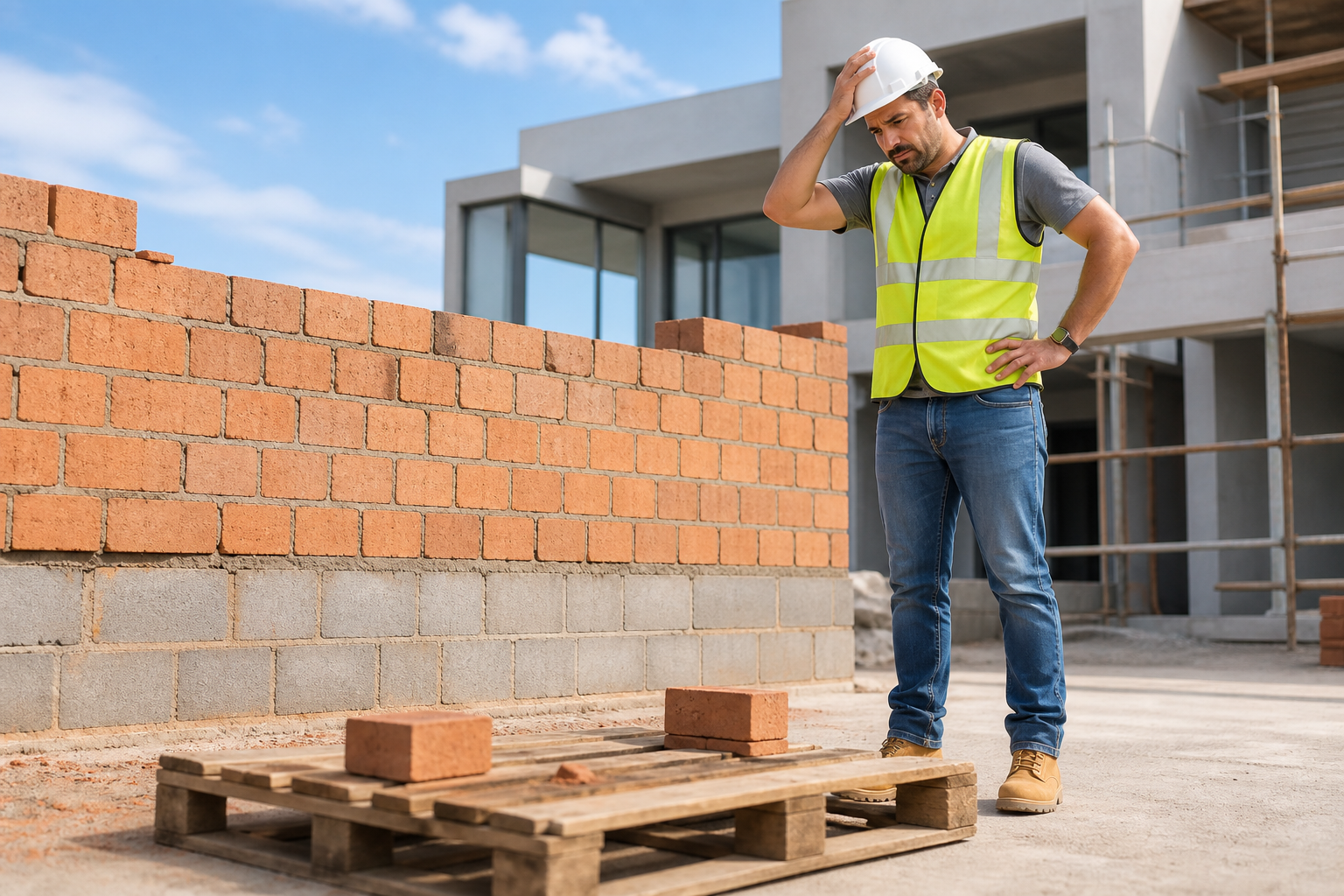
Ever rocked up to site thinking you had enough bricks, only to realise by lunchtime you’re staring at a half-finished wall and an empty pallet? Calculating brick quantity isn’t just a numbers game—it’s the difference between looking like a pro and playing Tetris with leftovers. This guide will arm you with the right formulas, handy tips, and a worked example in both metric and imperial. No more guesswork, no more panicked runs to the builder’s merchant.
Why Getting Your Brick Quantity Right Matters
Here’s the bit most people get wrong: ordering bricks isn’t just measuring the wall and calling it a day. Under-order and you’ll be stuck mid-build, hoping the next batch matches. Over-order and you’ve paid for a mountain of bricks that’ll haunt your garden for years—unless you’re planning an avant-garde barbecue. Like writing your shopping list with both apples and oranges in mind, you need to work in one set of units, factor in mortar gaps, and allow for a sensible bit of wastage.
The Brick Counting Basics
Before you whip out the tape measure, remember: bricks come in different sizes depending on where you are. In the UK, the standard is 215mm x 102.5mm x 65mm (8.5in x 4in x 2.5in). In the US, a common brick size is 194mm x 92mm x 57mm (7 5/8in x 3 5/8in x 2 1/4in). Always check what your local supplier is selling—measuring in metric then ordering in imperial is like baking a cake with two sets of scales and hoping it rises.
Step-by-Step: How to Calculate Brick Quantity
1. Measure Your Wall (or Project) Area
- For a straightforward wall, multiply height by length.
- Always use one set of units for everything—either metres/centimetres (metric) or feet/inches (imperial).
2. Work Out the Area Covered by One Brick (Including Mortar Joint)
- Add the mortar joint (usually 10mm/0.4in) to the brick’s height and length.
- Multiply the adjusted length by the adjusted height.
3. Calculate Number of Bricks Needed
- Divide the total wall area by the area covered by one brick.
- Add a wastage allowance—usually 5-10% (that’s the spare teabags theory: always keep a few extra so you’re never caught short).
The Formula (Metric Example):
Number of Bricks = (Wall Height (m) x Wall Length (m)) / ((Brick Height + Mortar) (m) x (Brick Length + Mortar) (m))
And for imperial:
Number of Bricks = (Wall Height (ft) x Wall Length (ft)) / ((Brick Height + Mortar) (ft) x (Brick Length + Mortar) (ft))
Worked Example: Calculating Bricks for a 3m x 5m (10ft x 16.5ft) Wall
Let’s say you’re building a single skin wall that’s 3m high by 5m long (10ft x 16.5ft). Using standard UK bricks and a 10mm (0.4in) mortar joint:
Metric:
- Wall area: 3m x 5m = 15m²
- Brick (with mortar): (0.215m + 0.01m) x (0.065m + 0.01m) = 0.225m x 0.075m = 0.016875m² per brick
- Bricks needed: 15m² / 0.016875m² ≈ 889 bricks
- Add 10% wastage: 889 x 1.10 ≈ 978 bricks
Imperial:
- Wall area: 10ft x 16.5ft = 165ft²
- Brick (with mortar): (8.5in + 0.4in) x (2.5in + 0.4in) = 8.9in x 2.9in = 25.81in²
- Convert to ft²: 25.81in² ÷ 144 = 0.1793ft² per brick
- Bricks needed: 165ft² / 0.1793ft² ≈ 920 bricks
- Add 10% wastage: 920 x 1.10 ≈ 1,012 bricks
Table: Metric vs Imperial Comparison
| Wall Size | Per Brick (inc. mortar) | Bricks (no wastage) | Bricks (10% wastage) |
|---|---|---|---|
| 3m x 5m (15m²) | 0.0169m² | 889 | 978 |
| 10ft x 16.5ft (165ft²) | 0.1793ft² | 920 | 1,012 |
Nobody has ever finished a wall and said, “Wish I’d bought fewer bricks.” Trust me, you’ll thank yourself for rounding up.
Don’t Forget the Openings (Doors & Windows)
Bet the merchant never told you this: always subtract the area of any doors or windows from your total wall area. Otherwise, you’ll end up with enough bricks to wall up the front door (great for keeping the in-laws out, less good for resale value).
Other Brickwork Scenarios
- Double skin (cavity) walls: Double your brick count for the extra layer.
- Piers or corners: Add a few extras—these always eat more bricks than you think.
- Arches, features or soldier courses: Allow for specials, as standard bricks might not fit the bill.
Why Bother With a Brick Calculator?
Look, you could do this all by hand, or you could use an online calculator to take out the faff (and risk of dodgy maths after a long week). Calculators make it easy to switch between units, factor in wastage, and handle odd-shaped projects. While you’re at it, don’t forget the fixings—if you’re putting up plasterboard (drywall) anywhere nearby, our plasterboard screw quantity calculator will save you another trip to the merchant.
Handy Tips for Ordering Bricks
- Always order full packs if possible—loose bricks cost more and are more likely to get chipped.
- Check supplier minimums—nothing says “awkward” like ringing up for sixteen bricks.
- If you’re mixing units, convert everything to the same system before you start. Measuring the wall in feet and the brick in millimetres is a game nobody wins.
- Keep your wastage sensible—5% for neat, straight runs; 10% for anything with odd shapes or lots of cuts.
- For other fixings and project parts, our plasterboard screw quantity calculator has you covered.
Questions People Are Actually Asking
How to calculate brick quantity?
Measure the total area of your wall (length x height), then divide by the area covered by one brick (including a standard mortar joint). Don’t forget to add 5-10% extra for wastage.
How much brick do I need calculator?
A brick quantity calculator does all the hard work for you—just enter your wall dimensions, brick size (with mortar gap), and wastage percentage. For other materials like plasterboard screws, see our plasterboard screw quantity calculator.
How many bricks per sq ft?
For standard UK bricks, you’ll need about 4.5–5 bricks per square foot (1ft²), including a typical mortar joint. For US bricks, it’s about 6–7 per square foot, as they’re a tad smaller.
How many bricks per sqm?
In metric, standard UK bricks need around 60–65 bricks per square metre (1m²), including mortar. Always double-check your actual brick size and joint width, as patterns and types can vary.
How to calculate brick quantity in a wall in feet?
Measure the wall’s height and length in feet, multiply for total area (ft²), then divide by the area covered by one brick (brick length x height, plus mortar, in ft²). Add your wastage on top.
How to measure brick quantity in m3?
If you’re working in cubic metres (m³), usually for solid brickwork, calculate the wall volume (height x length x width, all in metres), then divide by the volume of one brick (with mortar). For standard UK bricks: about 500–550 bricks per m³. Adjust for your actual brick size.
How to calculate amount of brick needed?
Add up your total project area, subtract any openings, and divide by the area of one brick (with mortar). Then round up for wastage. If that sounds like a faff, plug your figures into a calculator—just make sure you’re using the right units.
Conclusion
Getting your brick quantity right is half science, half common sense, and a fair bit of “measure twice, count once.” Use the formulas above, allow for wastage, and you’ll never get caught out halfway up the wall. And if you’re mixing in plasterboard (drywall) on the same job, make life easier with our plasterboard screw quantity calculator. Happy building—just don’t blame us if you suddenly become the go-to brick expert on site!
Free tools to put this into practice
Reading is one thing — working out your own numbers is what saves time and money. Here are the free HowMuchDoINeed calculators that pair best with this guide:
- Brick Calculator Vs Manual Method Accuracy For Uk Walls — work out exactly how much you need and what it will cost.
- Block Paving Calculator Builders Guide — get an instant materials estimate for your project.
- Brick Calculator — size up quantities and costs before you head to the merchant.
- Tile Quantity Calculator — plan your order so you avoid over- or under-buying.
Explore every free calculator on HowMuchDoINeed — no sign-up required.