
Render Mix Calculator: Get Your Ratios Right and Never Run Out (or Overorder) Again
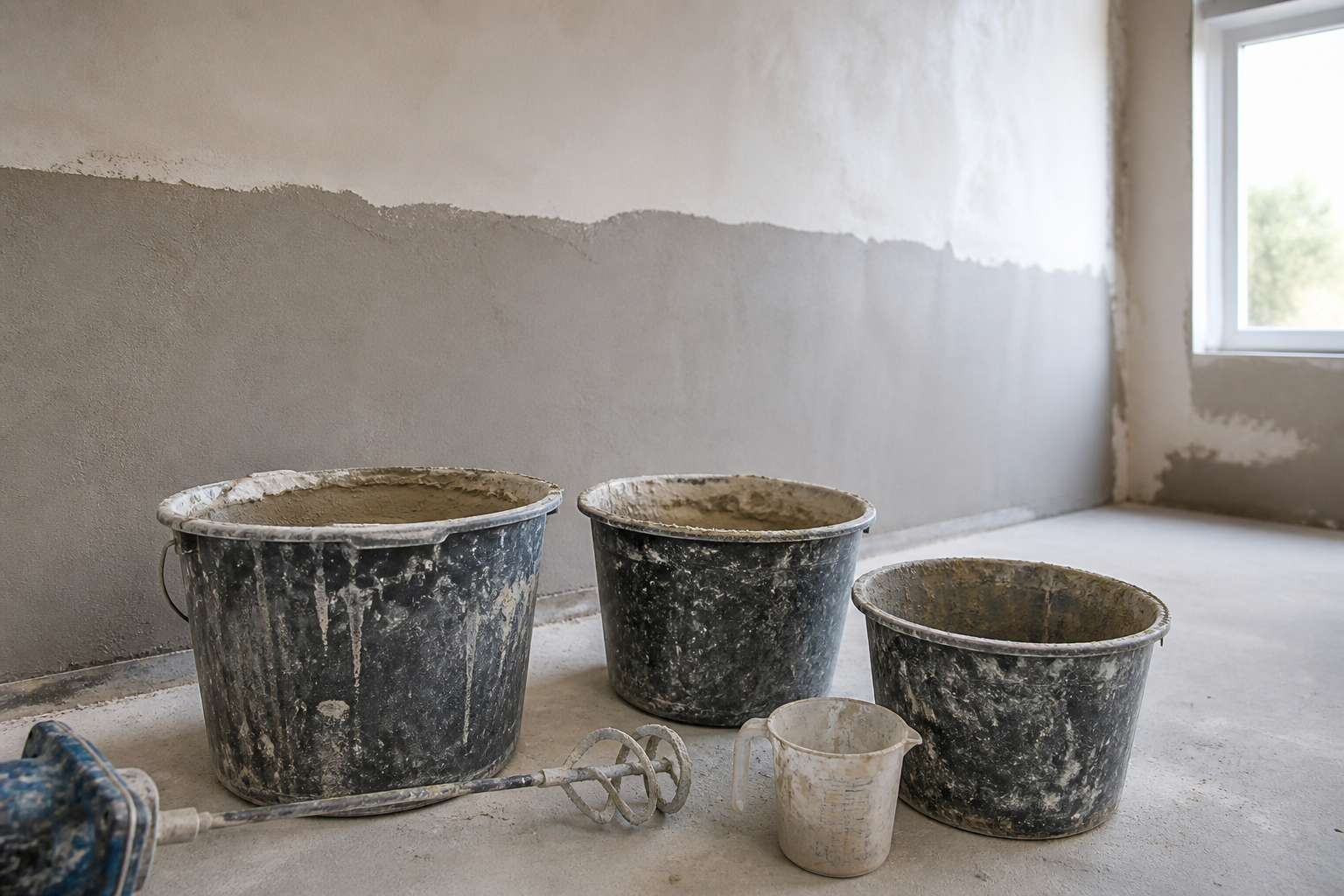
Ever got halfway up a wall and realised you’re a bucket short on render mix? Or mixed up a batch so stiff it’s more suited to sculpture than smooth rendering? Yeah, we’ve all been there. Ordering and mixing render is a bit like brewing tea for a crowd: get your ratios and quantities wrong, and someone’s left with a mug of disappointment. This guide will show you exactly how much render mix you need per square metre (or per square foot), how to nail the ratios for water, lime, SBR, and waterproofer, and — crucially — how to avoid costly mistakes.
What Actually Goes in a Render Mix? (And Why the Ratios Matter)
Let’s not overcomplicate this: render (UK) or stucco (US/AUS) is basically your classic sand and cement, but often with a dash of lime, plasticiser, waterproofing agent, or SBR for some extra magic. The golden ratio? For most jobs, it’s:
- 4 parts sharp sand (aggregate/gravel)
- 1 part cement (by volume)
- 1 part lime (optional, but makes for a smoother finish and happier trowels)
For a basic render, you’re looking at a 4:1:1 sand:cement:lime mix by volume. That means for every shovel full of cement, chuck in four of sand and one of lime. (If you’re working in the US, think 4 buckets sand, 1 bucket Portland cement, 1 bucket lime.)
Want to take the guesswork out of it? The concrete volume calculator will do the sums for you, whether you’re working in metric or imperial.
How Much Render Mix Per m² (and Per ft²)?
Here’s the bit everyone gets wrong: coverage. Most renderers underestimate the thickness, or forget about the wastage that gets slopped on the floor. The standard thickness for render is 15mm (just over 1/2 inch) for external walls. For internal, you might get away with 10mm (about 3/8 inch).
Let’s crunch some numbers:
Coverage Table:
| Thickness | Per m² (metric) | Per ft² (imperial) |
|---|---|---|
| 10mm (3/8") | 0.01 m³ | 0.36 ft³ |
| 15mm (5/8") | 0.015 m³ | 0.54 ft³ |
So, for every 1m² (10.8ft²) of wall at 15mm (5/8") thickness, you need 0.015m³ (0.54 ft³) of render mix. That’s about 15 litres (4 US gallons) of mixed material per m² (10.8ft²).
Wastage warning: Always add at least 10% for wastage — it’s like those spare teabags you keep in the van so you’re never caught short. Trust me, nobody ever finished a job wishing they’d bought less render.
Worked Example: Calculating Render Mix for a Wall
Let’s say you’ve got a 5m x 2.4m (16ft x 8ft) wall, and you want to apply a 15mm (5/8") render coat.
Step 1: Work out the area.
- 5m x 2.4m = 12m² (16ft x 8ft = 128ft²)
Step 2: Work out the volume needed.
- 12m² x 0.015m (thickness) = 0.18m³ of render (128ft² x 0.054ft (thickness) = 6.91ft³)
Step 3: Add 10% wastage.
- 0.18m³ x 1.10 = 0.198m³ (6.91ft³ x 1.10 = 7.6ft³)
Step 4: Convert volume to bags (assuming 25kg/55lb bags).
- 1m³ of render weighs roughly 2,000kg (4,400lb).
- So, 0.198m³ x 2,000kg = 396kg (873lb)
- At 25kg (55lb) per bag, you’ll need about 16 bags (396 ÷ 25 = 15.84).
Want to check your own wall size? The concrete volume calculator will do the heavy lifting for you — just pop in your area and thickness.
Don’t Forget the Extras: Water, Lime, SBR & Waterproofer
Here’s where most DIYers (and a few pros) come unstuck — the add-ins. Too much water and your mix slumps off the wall like warm butter. Not enough SBR or waterproofer, and you might as well put up a sponge.
Water: How Much Goes In?
Aim for about 8–10 litres (2–2.5 US gallons) per 25kg (55lb) of cement. Go by feel: it should be workable, but not runny. If it slides off your trowel before you reach the wall, you’ve gone too far. Think mashed potatoes, not soup.
Waterproofer: The Right Dose
For most liquid waterproofers, use 100–200ml (3.5–7 US fl oz) per 25kg (55lb) of cement — always check the label, though. For plastering, stick to the lower end (100ml/3.5fl oz) to avoid affecting the bond.
SBR: How Much to Add?
For general render, add SBR at 0.5–1 litre (17–34 US fl oz) per 25kg (55lb) of cement. For plastering, go for the lower end. Adding too much is like putting six sugars in your tea: more isn’t always better.
Lime: The Classic Smoother
If you’re going for that buttery finish, add 1 part lime to your mix (see above for ratios). Hydrated lime is the stuff for render — don’t use quicklime, unless you fancy a chemistry lesson and a trip to A&E.
Plasticiser: Don’t Overdo It
Just a capful (about 75ml/2.5 US fl oz) per 25kg (55lb) of cement is plenty. It stops your mix going stiff and claggy, but too much and you’ll have bubbles popping all over your finished surface.
If this is all sounding a bit like a science experiment, the concrete volume calculator can help you get the main mix right, so you only need to adjust the extras.
Questions People Are Actually Asking
How much render mix per m2?
For 15mm (5/8") thickness, you need about 0.015m³ (15 litres or 4 US gallons) of render per m² (10.8ft²). Always add 10% for wastage, so round up to 0.017m³ (17 litres or 4.5 US gallons) per m².
How much waterproofer in render mix?
Use 100–200ml (3.5–7 US fl oz) of waterproofer per 25kg (55lb) bag of cement. Check the label of your chosen product, but this range covers most brands.
How much SBR in render mix?
Add 0.5–1 litre (17–34 US fl oz) of SBR per 25kg (55lb) of cement. Use the lower end for plastering and the higher end for external render or areas exposed to weather.
How much plasticiser in render mix?
About 75ml (2.5 US fl oz) of plasticiser per 25kg (55lb) of cement is plenty. More than that and your mix can become too airy.
How much lime in render mix?
Add 1 part hydrated lime to a standard 4:1 sand:cement render mix (so 4:1:1 by volume — four parts sand, one part cement, one part lime). This gives a smoother, more workable finish.
How much water in render mix?
Aim for 8–10 litres (2–2.5 US gallons) per 25kg (55lb) of cement, but always adjust by feel. The mix should be workable, not runny — think thick porridge, not cake batter.
How much SBR to add to render mix for plastering?
For plastering, stick to the lower end: about 0.5 litre (17 US fl oz) of SBR per 25kg (55lb) of cement will improve adhesion and flexibility without overdoing it.
Wrapping Up: Don’t Guess, Calculate (and Finish With a Smile)
Ordering render mix without a proper take-off is like measuring your timber in feet and your wall in metres, then hoping it’ll all work out. Use the concrete volume calculator to get your base quantities bang on, and follow these ratios for a mix that goes on smooth and stays put. Next time you’re at the merchant, you’ll know exactly what to order — and never find yourself three bags short when the wall’s half done.
Free tools to put this into practice
Reading is one thing — working out your own numbers is what saves time and money. Here are the free HowMuchDoINeed calculators that pair best with this guide:
- Cement Plaster Mix Calculator — work out exactly how much you need and what it will cost.
- Concrete Mix Calculator — get an instant materials estimate for your project.
- Block Paving Calculator Builders Guide — size up quantities and costs before you head to the merchant.
- Drywall Sheet Calculator Builders Guide — plan your order so you avoid over- or under-buying.
Explore every free calculator on HowMuchDoINeed — no sign-up required.