Patio Area Calculator: Nail Your Patio Size First Time (No Guesswork, No Drama)
Ever stood in your garden, patio slabs in hand, and realised your 'guesstimate' of the area was about as accurate as a weather forecast in April? If you’ve ever ended up with a patio that’s either comically too small or a slab short of the full set, you’re not alone. Let’s fix that. Here’s how to measure and plan a patio area properly (in both metric and imperial units), with a worked example, plus a link to the only patio area calculator you’ll ever need.
Why Getting Patio Area Right Actually Matters
Let’s put it this way: ordering patio materials without measuring properly is like doing your weekly shop with no list and a blindfold. You’ll either be hauling back bags you didn’t need or making a second trip for the milk (or slabs, in this case). An accurate area take-off means:
- You buy the right amount of paving, sand, and sub-base — no more, no less.
- You avoid awkward patch jobs or weird offcuts at the edges.
- You keep the project (and your wallet) tidy.
How to Measure Patio Area (Metric & Imperial)
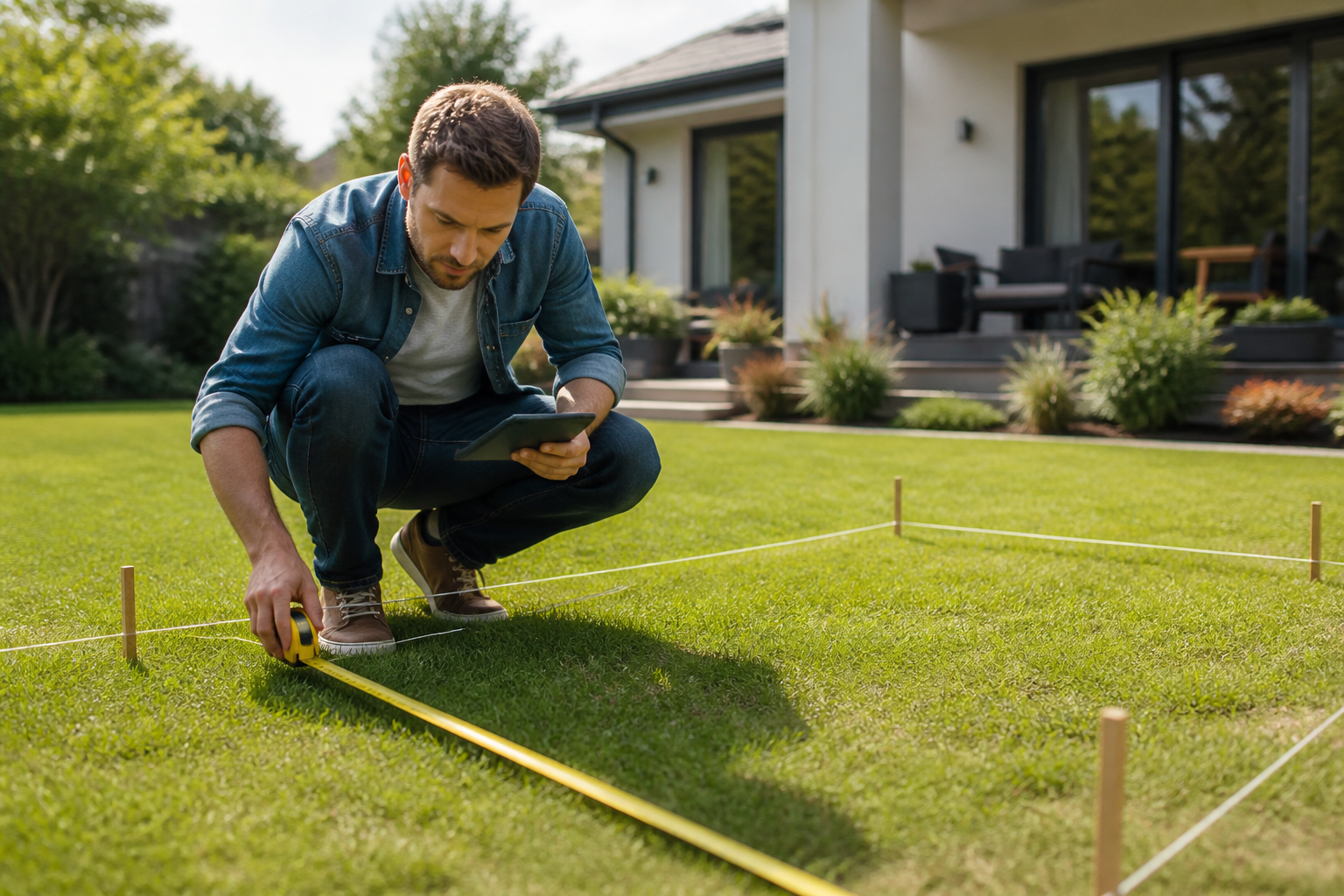
Here’s the bit most people get wrong: don’t just pace it out and hope for the best. Grab a tape measure, a notepad, and maybe a mate if you’re measuring a big space. Whether you work in metres (m) or feet (ft), the principle is the same.
Simple Rectangle or Square Patio
- Measure the length and width of your planned patio area.
- Write both down — trust me, you won’t remember them by the time you get to the builder’s merchant.
- Multiply length by width to get the area.
Formula:
- Metric: Area (m²) = length (m) × width (m)
- Imperial: Area (ft²) = length (ft) × width (ft)
Worked Example
Let’s say your patio is 4m x 3m (13ft x 10ft):
| Unit | Length | Width | Area |
|---|---|---|---|
| Metric | 4m | 3m | 12m² |
| Imperial | 13ft | 10ft | 130ft² |
So, you’ll need enough slabs, sub-base, and sand to cover 12m² (130ft²). If you want to double-check your sums (or just hate maths), our patio area calculator does it for you — just punch in your measurements and let it do the heavy lifting.
Odd-Shaped Patios: L-Shapes and More
Bet the merchant never told you this trick: break your weirdly shaped patio into rectangles or squares, work out the area of each, then add them up. This is much easier than trying to measure around every nook and cranny in one go. The patio area calculator is built to handle these combos too.
What About Wastage?
Here’s a golden rule: nobody has ever finished a job saying they wish they’d bought less. Always add about 10% extra to cover breakages, cuts, and that one slab you’ll inevitably drop on your toe. Think of wastage like the spare teabags you keep so you’re never caught short — a little insurance never hurts.
- For 12m² (130ft²) patio: 10% extra = 13.2m² (143ft²) to order
Patio Materials: How Area Helps You Order
Knowing your area isn’t just for show. You’ll need it to order:
- Paving slabs (patio pavers)
- Sub-base (MOT type 1/road base)
- Sharp sand (for bedding)
- Jointing compound
Manufacturers list coverage per pack or per slab in both metric (m²) and imperial (ft²). Just divide your total area (with wastage) by the coverage per pack. If you want to get it right on your first order, plug your measurements into the patio area calculator and let it do the sums.
How to Prep and Plan Your Patio Area
Designing and prepping your patio isn’t just about picking a spot and hoping for the best. Here’s what you need to think about:
- Mark it out: Use string lines and pegs (or a garden hose for curves) to lay out your patio’s edges.
- Check your levels: Patios need to fall away from buildings — about 1:60 slope (16mm per metre, or 3/16in per foot) — so rainwater doesn’t end up in your lounge.
- Remove turf and soil: Dig down to a depth that allows for sub-base, sand, and slab thickness (usually 150mm-200mm or 6-8in total).
- Lay sub-base: Compact your MOT type 1/road base in layers to avoid the patio sinking faster than your hopes of a dry British summer.
- Bedding layer: Sharp sand (about 30-50mm or 1-2in thick).
- Lay paving: Start from a straight edge and work out. Use spacers or string to keep it neat.
Patio Area: Worked Example in Action
Let’s say you’ve measured up for a 4m x 3m (13ft x 10ft) patio:
- Area: 12m² (130ft²)
- With 10% wastage: 13.2m² (143ft²)
- Slab size: 600mm x 600mm (24in x 24in) — each covers 0.36m² (4ft²)
- Number of slabs needed:
- Metric: 13.2m² ÷ 0.36m² = 36.7, round up to 37 slabs
- Imperial: 143ft² ÷ 4ft² = 35.75, round up to 36 slabs
Mismatched units? Don’t do it. It’s like measuring the room in feet and ordering timber in metres — a recipe for a headache. The patio area calculator keeps it all straight.
Questions People Are Actually Asking (FAQ)
How big is an average patio?
In most gardens, the average patio is around 12m² to 20m² (130ft² to 215ft²). That’s enough for a table, chairs, and a BBQ — or, if you're unlucky, just enough for the in-laws to turn up uninvited. But there’s no rule: size yours to suit your space and what you want to use it for.
How much does the average patio cost?
Costs vary wildly depending on your location, materials, and labour (if you’re paying someone instead of bribing a mate with a cold drink). As a rough guide, expect the materials for a basic patio to run from modest to mortgage-worthy. Always get a few local quotes and measure your area accurately before budgeting.
How to measure a patio area?
Measure the length and width of your planned patio (in metres/feet), multiply them together, and add 10% for wastage. For odd shapes, split it into rectangles, measure each, and add them up. Or let the patio area calculator handle it for you.
How to level a patio area?
After digging out, use a long spirit level (or a taut string line) to set your sub-base with a slight fall away from buildings (about 1:60 slope — 16mm per metre or 3/16in per foot). Compact everything as you go to avoid sinkholes later.
How to prep patio area for pavers?
Mark out your area, dig down to allow for sub-base, sand, and slab thickness (typically 150-200mm or 6-8in total). Lay and compact the sub-base, then your bedding layer of sharp sand, then set your pavers (slabs) on top — checking levels as you go.
How to design a small patio area?
Keep furniture scaled to the space, use lighter colours to make it feel bigger, and embrace clever tricks like diagonal paving or built-in seating. Even a 3m x 2m (10ft x 6.5ft) area can be an outdoor gem with a bit of planning.
How to arrange patio furniture areas?
Start with the biggest item (usually the table), leave enough space to pull chairs out (at least 1m or 3ft around the edge), and use outdoor rugs or planters to zone off areas if needed. Don’t cram — leave room to move about, especially if you want to avoid knocking your shins every time you fetch a burger.
Conclusion: Get Your Patio Area Bang On
Measuring your patio area properly is the foundation for a project that runs smooth — and actually fits your furniture, your family, and your Friday night plans. Don’t rely on guesswork or napkin maths. Give our patio area calculator a whirl to make sure you get it right first time — and save yourself the classic slab-shortfall shuffle.
Free tools to put this into practice
Reading is one thing — working out your own numbers is what saves time and money. Here are the free HowMuchDoINeed calculators that pair best with this guide:
- Concrete Patio Calculator — work out exactly how much you need and what it will cost.
- Landscape Area Calculator Square Footage Meter — get an instant materials estimate for your project.
- Fencing Area Calculator Square Footage Metre Guide — size up quantities and costs before you head to the merchant.
- Area Calculator — plan your order so you avoid over- or under-buying.
Explore every free calculator on HowMuchDoINeed — no sign-up required.