
Concrete Patio Calculator: Nail Your Quantities, Dodge Costly Mistakes and Pour Like a Pro
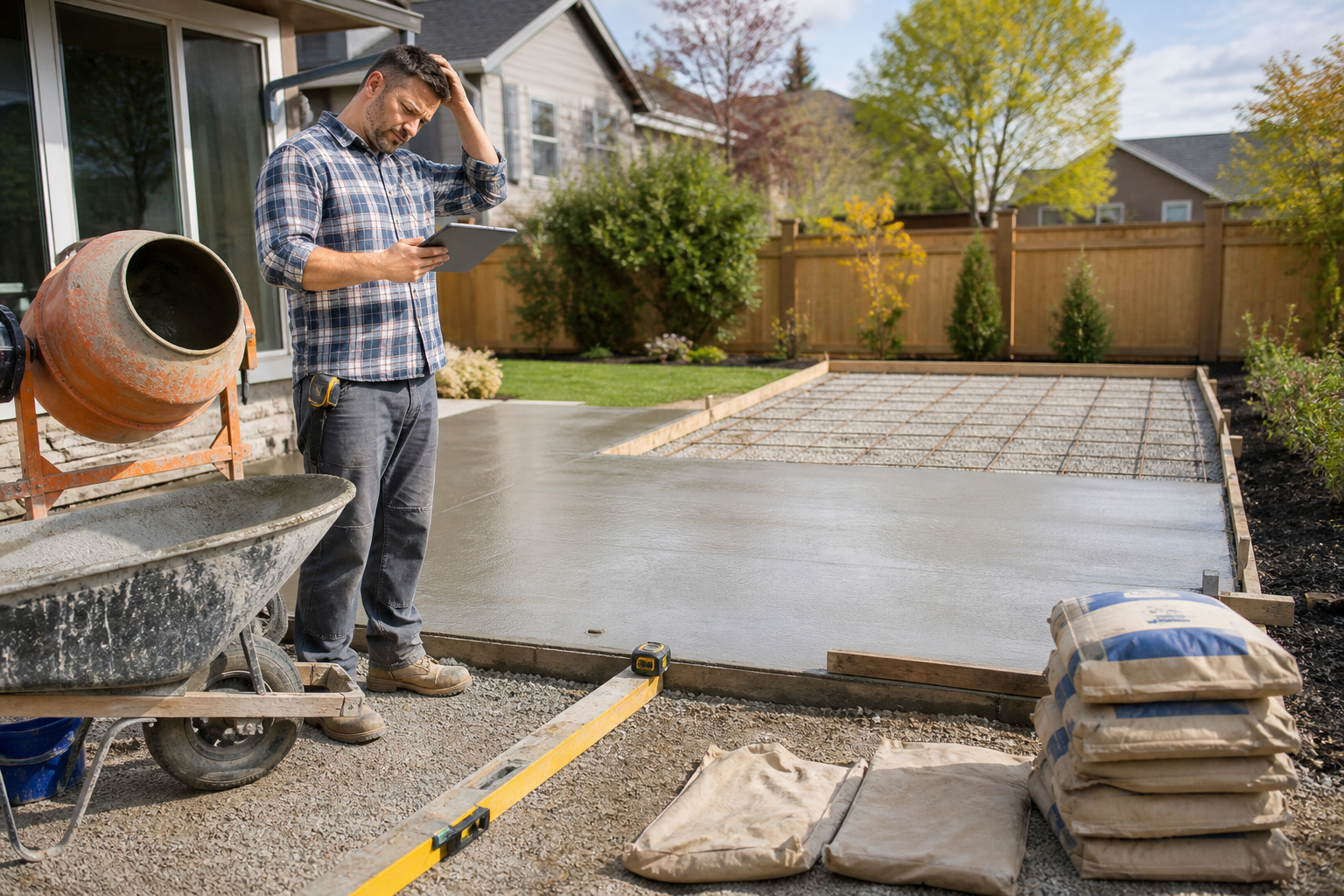
Ever finished a patio only to realise you’re two wheelbarrows short and the mixer’s already washed out? Or worse—ordered so much concrete you could’ve paved the drive as well? Figuring out how much concrete you need for a patio isn’t just a bit of maths; get it wrong and you’re wasting time, money, and your good mood. This guide will walk you through working out your concrete quantities with zero faff and no surprises on pour day—using both metric and imperial, so no one's left scratching their head.
Why You Actually Need a Concrete Patio Calculator
Here’s the bit most DIYers and even a few trades get wrong: concrete’s heavy, messy, and the one job where you really don’t want to run short. Ordering by the seat of your pants is like baking a cake with no measuring jug—sure, you might end up with something edible, but it won’t win any prizes.
A proper concrete volume calculator takes the guesswork out. You plug in your patio’s length, width, and depth (in metres/feet or millimetres/inches), and it spits out the exact volume you’ll need. No dodgy mental arithmetic. No waking up at 3am worrying if you’ve under-ordered.
How to Measure Up for a Concrete Patio (And Not Regret It Later)
Bet the merchant never told you this: always, always double-check your measurements before you order. Here’s how to get it right:
- Measure the length and width of your patio area. Use a tape measure, not your best guess. Record in both metres (m) and feet (ft) if you work in both systems.
- Decide on the thickness. Standard patio slabs go 100mm (4in) thick, but heavy loads (like cars) may need 150mm (6in).
- Multiply length × width × thickness to get the volume. Always convert the thickness to metres (or feet) to match your other measurements.
- Add a wastage allowance. 10% extra is your insurance policy—the spare teabags in your materials order. Trust me, nobody has ever wished they’d bought less concrete.
Worked Example: Calculating Concrete for a Patio
Let’s say you’re laying a new patio that’s 4m x 3m (13ft x 10ft), and you want it 100mm (4in) thick. Here’s how you’d work it out:
Metric:
- Length: 4m
- Width: 3m
- Thickness: 0.1m (100mm)
- Volume = 4 × 3 × 0.1 = 1.2 cubic metres
- Add 10% for wastage: 1.2 × 1.1 = 1.32 cubic metres
Imperial:
- Length: 13ft
- Width: 10ft
- Thickness: 4in (0.333ft)
- Volume = 13 × 10 × 0.333 = 43.29 cubic feet
- Add 10% for wastage: 43.29 × 1.1 = 47.62 cubic feet
To convert cubic feet to cubic yards (for US/Canada ready-mix): 47.62 ÷ 27 = 1.76 cubic yards
If maths isn’t your thing (or you just want to double-check), the concrete patio calculator will do this instantly—no calculator, no crossed fingers.
| Patio Size | Thickness | Metric Volume (m³) | Imperial Volume (yd³) |
|---|---|---|---|
| 4m x 3m | 100mm | 1.32 | 1.76 |
| 5m x 4m | 100mm | 2.2 | 2.88 |
| 12ft x 10ft | 4in | 1.09 | 1.48 |
| 20ft x 12ft | 4in | 2.26 | 3.06 |
Slope: The Bit Most People Forget
Here’s a classic: you lay a beautiful concrete patio, only to find out it holds water like a dodgy pint glass. You need a slope—typically 1:80 (so for every 80 units across, it drops 1 unit). For a 4m (13ft) wide patio, that’s a 50mm (2in) fall. Don’t worry, this doesn’t affect your overall volume much; just set your formwork to the right levels and order based on the maximum thickness. The concrete volume calculator lets you factor this in if you want to be extra precise.
Concrete Ordering: Bags or Ready-Mix?
- Ready-mix: Best for anything over 2m³ (2.6yd³ / 70ft³). Order by the cubic metre (or cubic yard). Most suppliers require minimum orders—don’t get caught out.
- Bagged concrete (dry mix): Good for smaller jobs. Bags are usually 25kg (55lb) in the UK/AU or 60lb/80lb in the US. Check the bag for coverage rates—usually about 0.011m³ (0.39ft³) per 25kg (55lb) bag.
Quick Bag Estimate:
- Total volume needed ÷ bag yield = number of bags
- Example: 1.32m³ needed ÷ 0.011m³ per bag ≈ 120 bags
- If you’re hauling these from the merchant yourself, consider a gym membership.
Common Pitfalls (and How to Dodge Them)
- Mixing units: Measuring the patio in feet but ordering concrete in metres is like trying to make tea with teaspoons and pints—something’s going to taste odd.
- Not allowing for waste: Always add 10%. Overspill, dodgy edges, spilt mixes… it all adds up.
- Forgetting about access: Can the truck get close, or are you barrowing 50m (160ft) round the house? You might need to split pours or use pumps.
- Ignoring the weather: Pouring in a monsoon or heatwave? You’ll either get a swimming pool or a race against the clock.
Questions people are actually asking
How much does a concrete patio cost?
Costs depend on your country, supplier, and finish. For the concrete alone, expect a range per cubic metre (cubic yard)—check local suppliers. Labour, reinforcement, and extras like edging or colour add to the total. Use the concrete volume calculator to get your required volume, then multiply by your local rate.
How much concrete do I need for a patio?
Measure your patio’s length, width, and thickness. Multiply them for volume, then add 10% for waste. For a quick answer, plug your sizes into a concrete patio calculator and let it do the heavy lifting.
How much cement do I need for a patio?
If you’re mixing your own, cement is just one ingredient—usually about 1 part cement to 2 parts sand and 4 parts aggregate (gravel). A 1.32m³ (1.76yd³) patio typically needs around 12–13 bags of cement (25kg/55lb each), but always check your mix ratio and bag instructions.
How much slope should a concrete patio have?
Aim for a minimum slope of 1:80 (about 12.5mm per metre, or 0.15in per foot) to shed water away from your house. For a 4m (13ft) patio, that means a 50mm (2in) drop from one end to the other. Set your formwork to match and check with a spirit level.
How thick should a concrete patio be?
Standard is 100mm (4in) for foot traffic. If you’re parking a car on it, go for 150mm (6in) reinforced. Thicker is usually better than thinner (unless you fancy watching your patio crack up after the first freeze).
How much is concrete patio per square foot (or per square metre)?
Rates vary, but you’ll need to work out your area and multiply by thickness for a true cost. Most suppliers price by the cubic metre (or yard), so use the calculator to get your volume, then divide by your area for a per-square-rate.
How much concrete for a backyard or porch slab?
Exactly the same method: measure length × width × thickness, add 10% for waste, and use a volume calculator if you don’t fancy the arithmetic. Remember, porches and backyard slabs usually need a minimum slope for drainage too.
Conclusion: Stop Guessing, Start Pouring (With No Regrets)
Ordering concrete for your patio doesn’t need to be a gamble. With a tape measure, a little maths (or a handy concrete volume calculator), and a dash of common sense, you’ll hit your quantities bang on—no more, no less. That’s less waste, less hassle, and more time enjoying your new patio (preferably with a cold drink in hand). Ready to find out exactly how much you need? Fire up the calculator and get pouring like a pro.
Free tools to put this into practice
Reading is one thing — working out your own numbers is what saves time and money. Here are the free HowMuchDoINeed calculators that pair best with this guide:
- Paving Slab Calculator Guide — work out exactly how much you need and what it will cost.
- Concrete Cost Calculator — get an instant materials estimate for your project.
- Concrete Mix Calculator — size up quantities and costs before you head to the merchant.
- Concrete Calculator Guide How Much Concrete Do I Need Complete Uk Diy Construction Guide — plan your order so you avoid over- or under-buying.
Explore every free calculator on HowMuchDoINeed — no sign-up required.