How to Calculate Fencing Area: Stop Guessing and Order the Right Amount First Time
Ever got halfway round your garden (yard) with new posts in hand, only to realise you’re two panels short and the merchant’s already closed? Yep, we’ve all been there. Calculating fencing area isn’t rocket science, but cock it up and you’ll either be making multiple trips for more supplies, or cursing that pile of leftover panels in the garage. Here’s how to get it right first time — in both metric (metres) and imperial (feet/yards) — so you can order smart and finish the job in one go.
Why Calculate Fencing Area?
Here’s the bit most people get wrong: fencing isn’t just about how long it is. Whether you’re pricing up materials, working out paint or stain, or figuring out coverage for privacy, you need both the length and the height — in other words, the area. Think of it like wrapping a present: you wouldn’t just measure one edge and hope for the best.
Step-by-Step: How to Calculate Fencing Area
Let’s break it down. You’ll need:
- The total length of fence you want to install (in metres/feet)
- The height you want for your fence (in metres/feet)
1. Measure Each Side
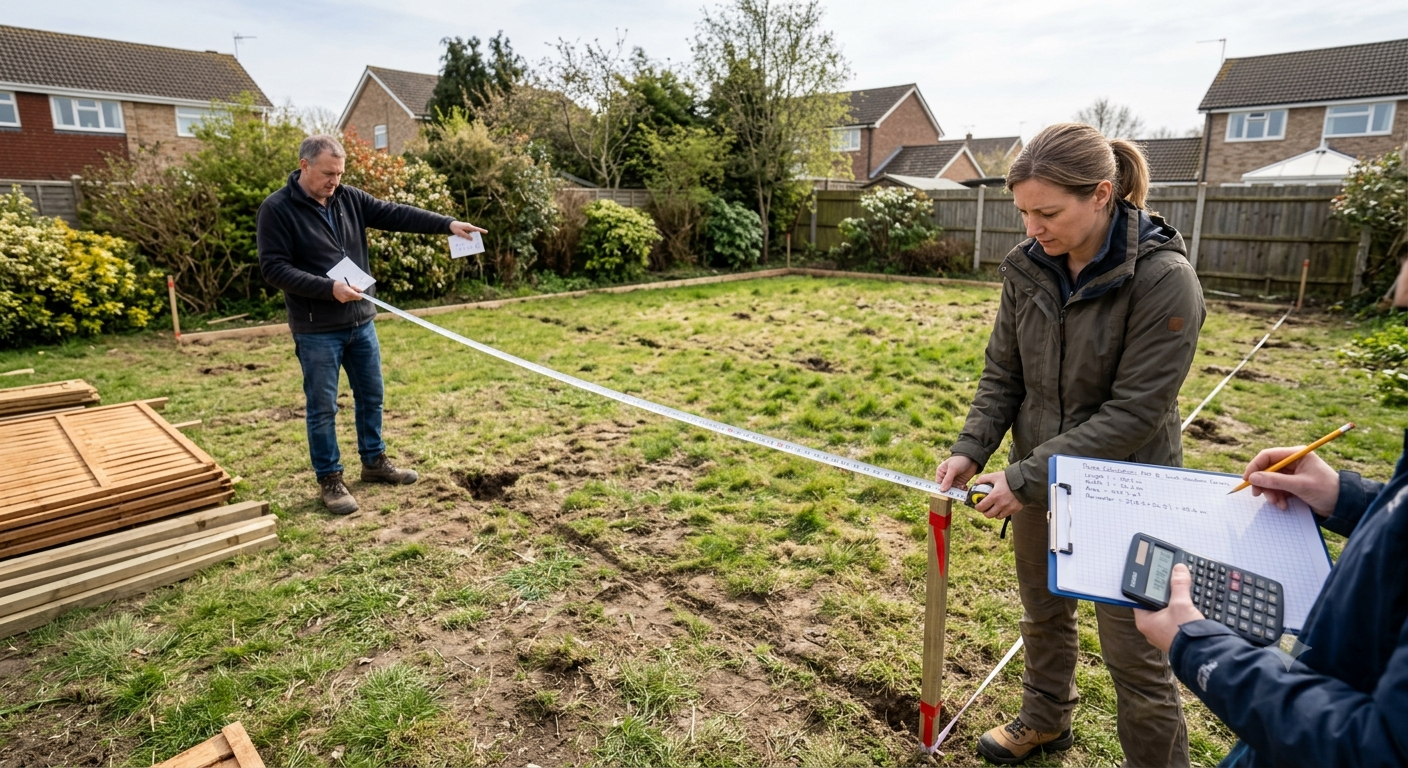
Walk the boundary and measure each section you want to fence. If it’s a rectangle or square, easy — just measure the four sides. If it’s a more creative shape, jot down each individual run.
- For metric: use a tape measure marked in metres (m) or centimetres (cm), then convert as needed.
- For imperial: use feet (ft) or yards (yd). Remember, 1 yard = 3 feet, and 1 metre ≈ 3.28 feet.
2. Add Up the Total Length
Sum all the sides that need fencing. For example:
- 10m + 15m + 10m + 15m = 50m total (32.8ft + 49.2ft + 32.8ft + 49.2ft = 164ft total)
3. Choose Your Fence Height
Standard fence panels are usually 1.8m (6ft), but you might go higher or lower depending on local rules or your nosy neighbour’s height.
4. Calculate the Area
Area = Total length × Height
- In metric: Area (m²) = length (m) × height (m)
- In imperial: Area (sq ft) = length (ft) × height (ft)
Worked Example
Let’s say you’re fencing a 12m x 8m (40ft x 26ft) garden:
- Perimeter = 12 + 8 + 12 + 8 = 40m (40 + 26 + 40 + 26 = 132ft)
- Fence height = 1.8m (6ft)
- Area = 40m × 1.8m = 72m² (132ft × 6ft = 792 sq ft)
So, you’ll need enough fencing to cover 72m² (792 sq ft).
Bet the merchant never told you this: always add 5-10% extra for wastage or awkward cuts. That’s your insurance against mis-measurements and panels that arrive with a chunk missing.
| Measurement | Metric (metres) | Imperial (feet) |
|---|---|---|
| Perimeter | 40m | 132ft |
| Height | 1.8m | 6ft |
| Area | 72m² | 792 sq ft |
| Add 10% | 79.2m² | 871 sq ft |
How to Work Out Fence Panels or Boards Needed
Now, knowing the area is handy for paint or stain, but if you’re buying panels (UK) or boards (US), you’ll want to know the count.
Panels: Standard panel is 1.8m x 1.8m (6ft x 6ft). Divide your total length by panel width.
- E.g., 40m ÷ 1.8m = 22.2 panels (round up to 23)
- 132ft ÷ 6ft = 22 panels
Boards/Pickets: If using individual boards, divide the total length by the width of a board, remembering to allow for gaps if it’s a picket fence.
- E.g., 100mm (4in) wide boards with a 10mm (0.4in) gap: 110mm (4.4in) per board
- 40m (1,575in) ÷ 0.11m (4.4in) ≈ 364 boards
- 132ft (1,584in) ÷ 4.4in ≈ 360 boards
Always round up. Nobody’s ever been glad they ordered less.
What About Slopes and Uneven Ground?
If your ground’s as flat as a snooker table, lucky you. For everyone else, measure the run as the crow flies, but check the actual panel height at the highest ground point. You may need to ‘step’ the fence or allow extra for longer posts (posts = ‘fence posts’ in the UK, ‘fence posts’/‘posts’ in the US).
Rural or Acreage Fencing: Quick Area Cheat
Fencing a field or paddock? One acre is about 63.6m × 63.6m (208.7ft × 208.7ft) if square.
- Perimeter = 4 × 63.6m = 254.4m (4 × 208.7ft = 835ft)
- Area = 254.4m × desired height (say 1.2m/4ft for stock)
- You’ll need at least 254.4m (835ft) of fencing material, posts every 2-2.5m (6-8ft), and gates as needed.
Top Tips: Avoiding Classic Fencing Mistakes
- Always double-check boundaries — nothing gets the neighbours talking like a fence six inches over the line.
- Order a little extra — offcuts come in handy, and you can always return unopened packs.
- Don’t mix units: measuring the run in feet and the panels in metres is asking for trouble.
- Take photos and mark measurements as you go. Your future self will thank you.
Questions people are actually asking
How to calculate fencing area?
Measure the full length of the boundary you want to fence (in metres and feet), choose your desired fence height (in metres and feet), then multiply length by height to get the area in square metres (m²) or square feet (sq ft). Always add 5-10% for wastage or awkward cuts.
How much is fencing per square foot?
Fencing cost per square foot (sq ft) varies by material and region, but you’ll typically pay more for solid timber/lumber, composite, or decorative panels. To get the cost, multiply the area you need (sq ft) by the price per sq ft for your chosen fence type. Always check if the price includes VAT/sales tax and installation.
How much is fencing per foot?
Fencing is often priced ‘per linear foot’ (or ‘per metre’). To work this out, take your total run length (in feet) and multiply by the supplier’s rate per foot. This usually covers the panels or boards only — posts, gravel boards, fixings, and gates are extra.
How much should fencing cost?
Fencing costs depend on material, height, and location. As a rule of thumb: cheap options like wire mesh or stock fencing cost much less per metre/foot than closeboard or composite panels. Always get quotes for the full job, including posts, fixings, and labour if you’re not DIYing.
How much is fencing per metre?
Suppliers often quote fencing per metre (UK/Australia/NZ) or per foot (US/Canada). Multiply your total metre run by the price per metre for your chosen fence. As with feet, this usually covers just the main panels or boards — extras are on top.
How much for fencing in a yard?
To fence a typical yard (garden), first measure the boundary length in both metres and feet. Work out your area using length × height, then multiply by the price per metre or foot, including posts and any gates. For a standard 10m x 10m (33ft x 33ft) yard at 1.8m (6ft) high, that’s 40m (132ft) of fencing.
How much fencing for 1 acre?
A square acre has a perimeter of about 254m (835ft). For a 1.2m (4ft) high stock fence, you’d need around 254m (835ft) of fencing, plus posts every 2-2.5m (6-8ft).
How to do rural fencing?
Rural fencing (for farms/paddocks) usually means wire mesh, barbed, or electric fencing, supported by timber/lumber or steel posts. Measure the full run (in metres/feet), plan posts at regular intervals, and allow for gates/corners. Always check local regulations on fence height and type for livestock.
Conclusion
Calculating your fencing area is like making a proper brew: measure carefully, allow for a bit of spillage, and don’t rush it. Whether you’re fencing a tiny terrace or the back forty, getting your numbers right up front means less faff and fewer surprises. Ready to get the right quantities? Use a fencing calculator to double-check your sums before you order. Happy fencing!
Free tools to put this into practice
Reading is one thing — working out your own numbers is what saves time and money. Here are the free HowMuchDoINeed calculators that pair best with this guide:
- Fencing Area Calculator — work out exactly how much you need and what it will cost.
- Roof Area Calculator — get an instant materials estimate for your project.
- Area Calculator — size up quantities and costs before you head to the merchant.
- Fence Calculator — plan your order so you avoid over- or under-buying.
Explore every free calculator on HowMuchDoINeed — no sign-up required.