Aggregate Calculator for Foundations: Nail Your Gravel Order First Time, Every Time
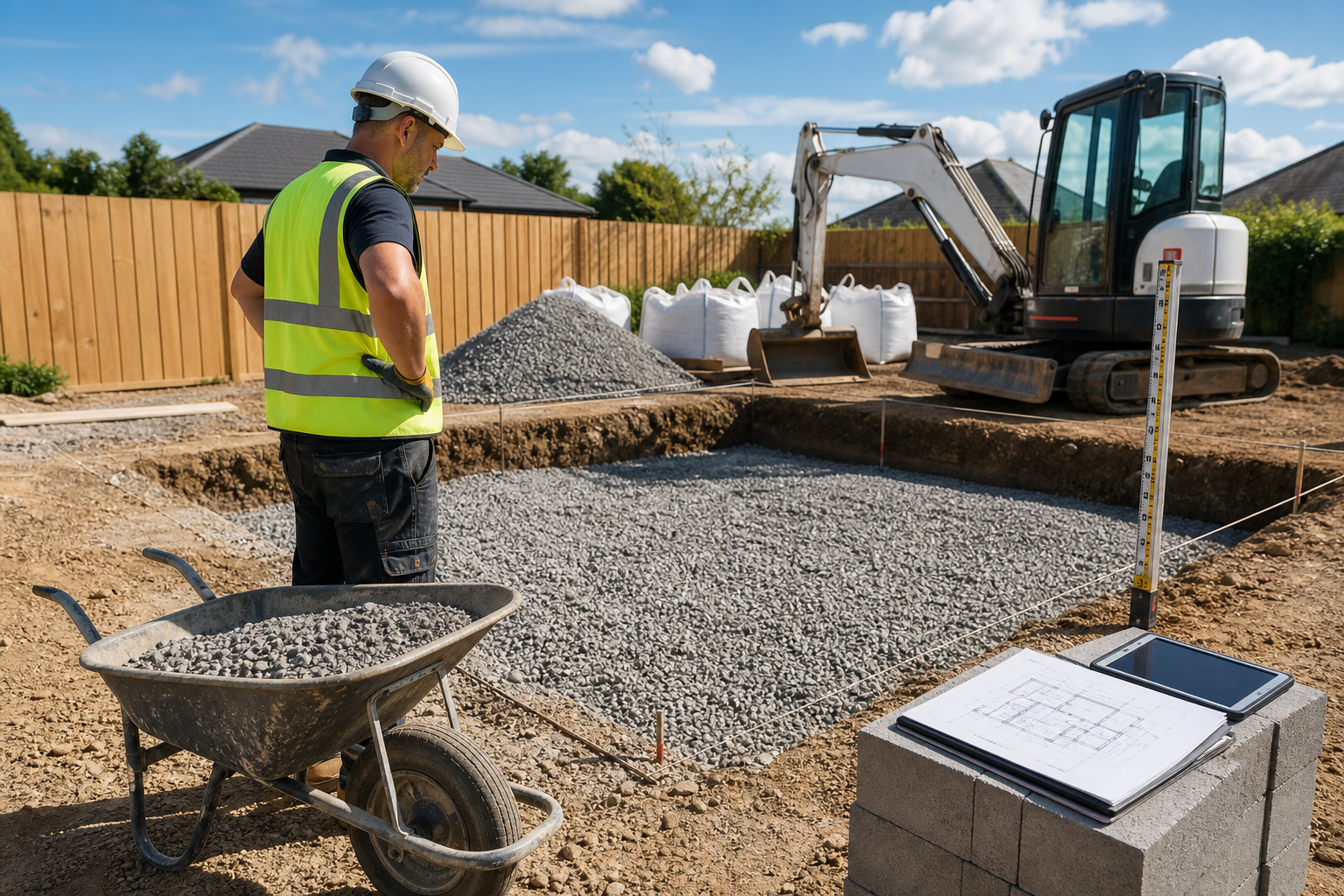
Ever found yourself shovelling the last barrow into a foundation, only to realise you’re a half tonne (half ton) short on aggregate? Or worse, you’ve ordered too much and now your driveway looks like a builder’s yard. Getting your gravel or aggregate take-off wrong is like laying footings with a wonky spirit level—messy, expensive, and guaranteed to haunt you later.
In this guide, you’ll learn exactly how to calculate aggregate for foundations, whether it’s for a shed, an extension, or a full-on house pad. We’ll cover the formulas, the must-have wastage allowance, and why the right aggregate size isn’t just a merchant’s upsell. Plus, there’s a worked example (with metric AND imperial units, because nobody wants to do back-of-a-fag-packet conversions on site). And for those who’d rather let a tool do the heavy lifting, you’ll get pointed straight to the aggregate calculator for foundations.
The Basics: What Is an Aggregate Calculation?
Here’s the bit most people get wrong: calculating aggregate isn’t just measuring the hole and ringing up the merchant. It’s about knowing how much loose stone, gravel, or MOT type 1 (road base) you need to fill a space, allowing for compaction, shape, and a bit of ‘just in case’—the same way you keep spare batteries for the site radio.
In a nutshell: aggregate calculation = length x width x depth (all in metres or feet) = volume. Then, adjust for compaction and wastage, and finally convert that volume to tonnes (metric tons)/US tons or cubic yards, depending on what your supplier deals in.
Why Getting Your Aggregate Calculations Right Matters
Ordering without a proper take-off is like doing your weekly shop with no list and a blindfold. Too little, and the job stalls. Too much, and you’re left explaining to the client why there’s a mountain of extra gravel in their garden. Merchants love a repeat order, but your wallet won’t.
Step-By-Step: How to Calculate Aggregate for Foundations
Let’s break it down like you would a tricky bit of formwork:
- Measure the Foundation Area—Length x Width = Surface Area
- Decide on Depth—Standard is 100–150mm (4–6in) for most shed bases and paths, but always check your spec.
- Calculate the Volume—Area x Depth = Volume required (in cubic metres or cubic feet)
- Convert to Weight or Bags—Suppliers sell by weight (tonnes, tons) or bag (25kg/55lb, bulk bags, etc.), so you’ll need to convert volume to weight. For MOT type 1/road base or similar, 1 cubic metre (1.3 cubic yards) is about 2.2 tonnes (2.4 US tons), but check your supplier’s data—density can vary.
- Add Wastage/Compaction Allowance—Always add 5–10% for waste and compaction. Think of it as the spare teabags at the back of the van—better to have too many than too few.
Worked Example: Aggregate for a Shed Base
Let’s say you’re building a classic 3m x 4m (10ft x 13ft) shed foundation, with a 100mm (4in) layer of MOT type 1 (road base). Here’s how you do it:
Step 1: Work Out the Volume
- Length: 3m (10ft)
- Width: 4m (13ft)
- Depth: 0.1m (4in)
Area = 3m x 4m = 12m² (10ft x 13ft = 130ft²)
Volume = 12m² x 0.1m = 1.2m³ (130ft² x 0.33ft = 42.9ft³)
Step 2: Convert Volume to Weight
- 1m³ of MOT type 1 = ~2.2 tonnes (2.4 US tons)
- 1ft³ = ~96lb of aggregate (varies by type; check supplier)
So:
- 1.2m³ x 2.2 tonnes = 2.64 tonnes (1.2 x 2.4 = 2.88 US tons)
- 42.9ft³ x 96lb = 4,118lb (divide by 2,000 for tons: 2.06 US tons, but check your aggregate type!)
Step 3: Add Wastage
- 10% of 2.64 tonnes = 0.26 tonnes
- Order 2.9 tonnes (3.2 US tons)
Or if you’re a bag buyer:
- Each bulk bag = 850kg (1,870lb)
- 2,900kg ÷ 850kg = 3.4 bulk bags (round up to 4)
Don’t fancy the maths? Save your brain for the build and use the aggregate calculator for foundations—it takes your measurements in metric or imperial and spits out the quantity you need in tonnes, bulk bags, or whatever your supplier asks for.
Table: Quick Reference Aggregate Densities
| Aggregate Type | Density (kg/m³) | Density (lb/ft³) | Tonnes/m³ (US tons/yd³) |
|---|---|---|---|
| MOT Type 1/Road Base | 2,200 | 137 | 2.2 (1.65) |
| Gravel (10-20mm/0.4-0.8in) | 1,800 | 112 | 1.8 (1.35) |
| Hardcore (Crushed Stone) | 1,600 | 100 | 1.6 (1.20) |
Always check with your supplier for exact numbers—these aren’t set in stone (pun barely intended).
What Size Aggregate for Concrete Foundations?
Bet the merchant never told you this: the size matters. For most concrete footings (aka footers), 20mm (0.75in) gravel or MOT type 1 is spot on—it compacts well, supports structural loads, and doesn’t leave big voids. Anything bigger, and you risk honeycombing; anything smaller, and it’s like pouring sand into your wellies—messy and unstable.
Top Tips for Ordering Aggregate Like a Pro
- Always round up. Nobody has ever finished a job saying they wish they’d bought less gravel.
- Double-check your units. Mixing up cubic metres and cubic yards is like measuring the room in feet and the timber in metres and hoping for the best.
- Allow for compaction and waste. That 10% extra is your insurance policy—don’t skip it.
- Use a calculator. Whether on paper, in your head, or (much easier) with the aggregate calculator for foundations, get the numbers sorted before you ring the merchant.
Questions People Are Actually Asking
How much aggregate calculator?
A good aggregate calculator, like the one at HowMuchDoINeed’s aggregate calculator for foundations, takes your measurements (length, width, depth) in either metric or imperial and instantly tells you how much aggregate you need—no mental gymnastics required. It saves time and reduces mistakes.
How to calculate aggregate?
Measure the length, width, and depth of your foundation in metres (feet), multiply them together to get the volume, then convert that volume to weight using the aggregate’s density. Don’t forget to add 5–10% for wastage and compaction.
What is an aggregate calculation?
It’s the process of working out how much gravel, MOT type 1, or other bulk material you need to fill a given space—usually for a foundation or base layer. It involves measuring, multiplying, and then converting to the supplier’s preferred unit (tonnes, tons, bulk bags, etc.).
How much gravel for foundation?
As a rule of thumb, a 100mm (4in) thick layer of MOT type 1 or gravel for a 3m x 4m (10ft x 13ft) shed base will need about 2.9 tonnes (3.2 US tons) or 4 bulk bags. Always check your actual site dimensions and use a calculator for the most accurate answer.
How much gravel for shed foundation?
For a standard 3m x 4m (10ft x 13ft) shed, with a 100mm (4in) deep base, you’ll need roughly 2.9 tonnes (3.2 US tons) or 4 bulk bags of aggregate. For other sizes, plug your numbers into the aggregate calculator for foundations.
What size aggregate for concrete footings?
For most footings (footers), 20mm (0.75in) gravel or MOT type 1 is the go-to. It compacts well and provides the right mix of stability and drainage for concrete work.
What aggregate is best for concrete?
Crushed stone or MOT type 1 (road base) in the 10–20mm (0.4–0.8in) range is ideal for most concrete foundations. Avoid rounded pea gravel for footings—it doesn’t lock together as well as angular stone.
Conclusion: Don’t Leave Your Aggregate Order to Chance
Calculating aggregate for foundations isn’t just a box-ticking exercise—it’s the difference between a smooth build and a last-minute dash to the merchant. Save yourself the stress (and the backache) by doing the sums right. And when in doubt, let the aggregate calculator for foundations do the heavy lifting for you. Your future self—and your wallet—will thank you.
Free tools to put this into practice
Reading is one thing — working out your own numbers is what saves time and money. Here are the free HowMuchDoINeed calculators that pair best with this guide:
- Aggregate Calculator — work out exactly how much you need and what it will cost.
- Decorative Gravel Calculator Landscaping Guide — get an instant materials estimate for your project.
- Block Paving Calculator Builders Guide — size up quantities and costs before you head to the merchant.
- Drywall Sheet Calculator Builders Guide — plan your order so you avoid over- or under-buying.
Explore every free calculator on HowMuchDoINeed — no sign-up required.