
Skip Volume Calculator: Nail Your Skip Size First Time (And Stop Overpaying for Thin Air)
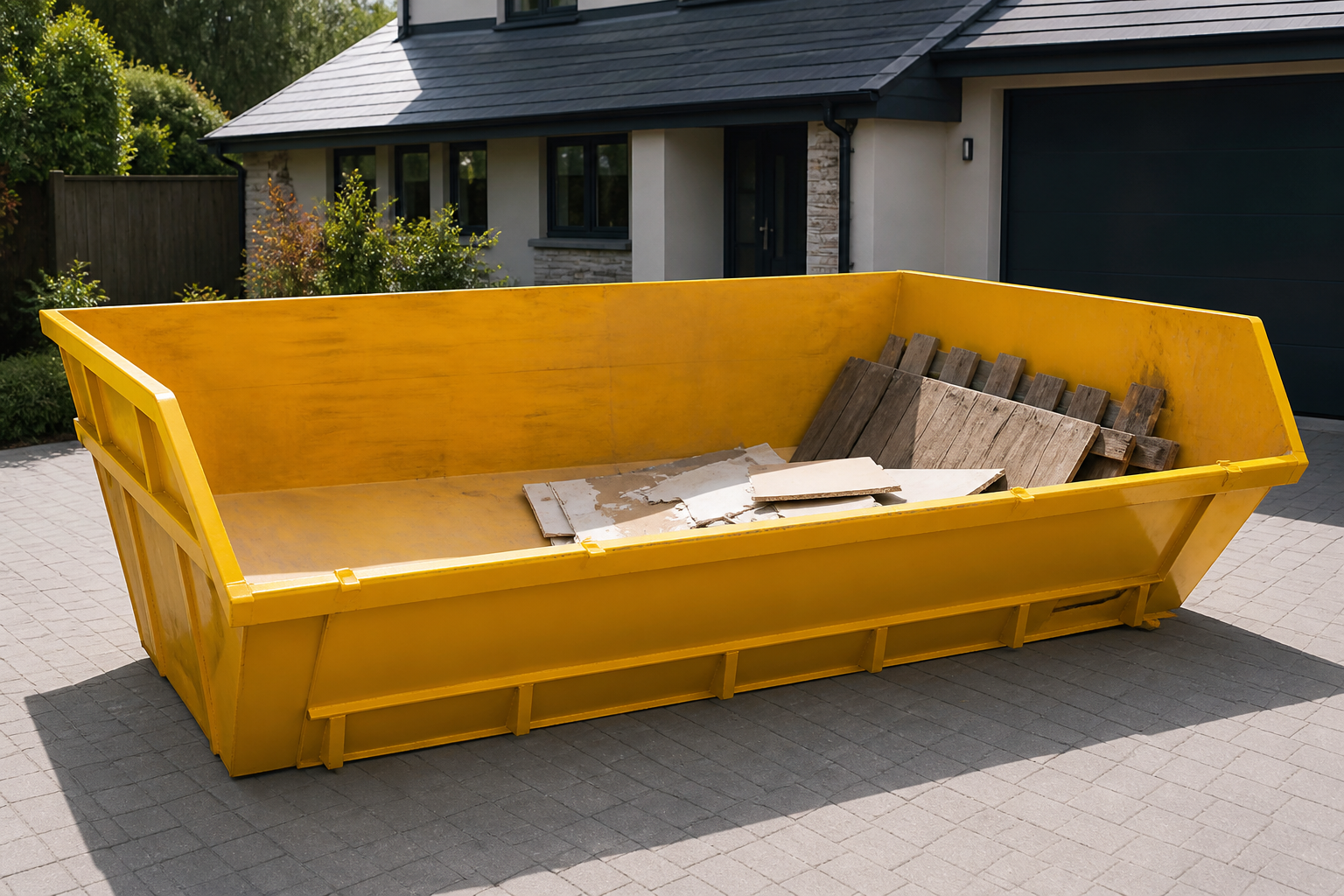
Ever stared at a mountain of rubble and thought, "What size skip do I actually need?" Or worse, paid for a skip so huge you could park a Transit van in it, only to fill half of it with old plasterboard (drywall) and a few sad fence panels? Picking the right skip size isn’t just about saving money—it's about not becoming the person who’s stacking rubbish up like a game of Jenga at the kerb (curb).
Let’s get properly stuck in: you’ll learn exactly how skip sizes work (both in metres and yards), how to measure your waste, convert the volume, and order the right skip like a pro. Plus, there’s a worked example with both metric and imperial, and a handy pointer to a water volume calculator that’ll stop the guesswork cold.
Skip Sizes Explained: Not All Skips Are Created Equal
Here’s the bit most people get wrong: skip sizes aren’t universal. In the UK and Ireland, you’ll hear skips sized in cubic yards (yd³), while the US, Canada, and Australia favour cubic yards too, but the container shapes and naming can vary. Metric fans, don’t worry—every skip has a volume in cubic metres (m³) as well.
To make things clearer, here’s a quick cheat sheet:
| Skip Size (Name) | Cubic Metres (m³) | Cubic Yards (yd³) | Typical Use Case |
|---|---|---|---|
| Mini Skip | 2 | 2.6 | Small clear-outs, garden waste |
| Midi Skip | 4 | 5.2 | Kitchen/bathroom refits |
| Builder’s Skip | 6 | 7.8 | Heavy waste, general building projects |
| Large/Maxi Skip | 8 | 10.5 | Full house clearances, bulky items |
| Roll-on Roll-off | 20–40 | 26–52 | Major demo, commercial jobs |
Rule of thumb: For every cubic metre (1m³ or 1.3yd³), you’ll get about 10 standard wheelbarrow loads or roughly 12–15 rubbish sacks (bin bags).
Ordering a skip without knowing your volume is like doing your weekly shop with no list and a blindfold—you’ll either come home with three types of cheese and no bread or, in this case, enough skip space to fit your neighbour’s shed as well.
How to Calculate Your Skip Volume (So You Don’t Overpay for Thin Air)
Bet the merchant never told you this: you can work out your own waste volume in minutes. Here’s how:
- Pile it up: Stack your waste as neatly as possible—think Lego, not Pick-Up Sticks.
- Measure it: Grab a tape, and note the length, width, and height of your rubbish pile in metres (and feet for our imperial friends).
- Do the maths: Multiply length × width × height.
- For metric: Volume in m³ = L (m) × W (m) × H (m)
- For imperial: Volume in ft³ = L (ft) × W (ft) × H (ft)
- To convert ft³ to yd³: Divide by 27 (since 1yd³ = 27ft³)
- To convert m³ to yd³: Multiply by 1.31 (since 1m³ ≈ 1.31yd³)
Worked Example: Calculating Skip Volume
Let’s say your pile of kitchen demo waste is 2m long, 1.5m wide, and 1m tall (that's about 6.5ft × 5ft × 3.3ft).
- Metric: 2m × 1.5m × 1m = 3m³
- Imperial: 6.5ft × 5ft × 3.3ft ≈ 107ft³; 107 ÷ 27 ≈ 4yd³
So, you’d want a midi skip (4m³/5yd³) to be safe—unless you fancy explaining to the driver why your pile’s now a sculpture on the pavement.
If you want to double-check your sums or have a pile that’s more puddle-shaped than a neat box, try a water volume calculator to calculate less obvious shapes or odd corners. It works for skips too—rubbish is just a solid liquid, right?
Skip Size Pitfalls (And How to Dodge Them Like a Pro)
- Under-ordering: Nobody has ever finished a job saying they wish they’d bought less skip. Always add 10% to your estimate—the spare teabags of the skip world.
- Over-ordering: Don’t pay for a skip that’ll echo when you throw in your last bit of plasterboard (drywall). Merchants love upselling, but only you know your waste.
- Waste type confusion: Check what’s allowed—plasterboard, soil, bricks, mattresses—some skips have rules tighter than a site foreman’s wallet.
- Permits: Need to put it on the street? That’s council paperwork and extra cost, so factor it in.
If in doubt, measure up and use a water volume calculator to get your cubic metres (or cubic yards) bang on.
Metric vs Imperial: Don't Mix & Match (Unless You Like Surprises)
Ordering a skip in metric but measuring your waste in feet is like measuring your room in feet and ordering your timber (lumber) in metres—something’s going to end up short. Always convert using the simple factors above, or let a water volume calculator do the grunt work for you.
What Can (and Can’t) Go in a Skip?
Quick checklist:
- Allowed: General household/building waste, wood, metal, plastic, garden waste, bricks, soil (check max weight)
- Not allowed: Asbestos, paint, solvents, tyres, fridges/freezers, batteries, gas cylinders, hazardous stuff
Always check with your skip hire company—rules do vary, and nobody enjoys fishing a forbidden mattress out at the last minute.
Questions people are actually asking
How do you calculate the volume of a skip?
Measure the length, width, and height of the skip (or your rubbish pile) in metres (or feet). Multiply them together for cubic metres (m³) or cubic feet (ft³). For cubic yards (yd³), divide your cubic feet by 27, or multiply your cubic metres by 1.31. If your pile isn’t a perfect box, estimate the average dimensions and round up. Or use a water volume calculator for trickier shapes.
What is the most common skip size for home projects?
For typical home clear-outs or small renovations, a 6-yard (4.6m³) builder’s skip is the UK’s go-to. In North America, a 10-yard skip (7.6m³) is popular for similar jobs. Always consider the weight limit if you’re chucking in heavy stuff like concrete or soil.
How much waste fits into a skip?
As a rough guide: a 6-yard (4.6m³) builder’s skip fits about 60–70 rubbish sacks (bin bags) or the equivalent of two small car loads. If your pile’s bigger than a family hatchback, step up a size. Always leave a bit of headroom—overfilling is a fast track to extra charges.
Can I mix different waste types in one skip?
Usually, yes for general mixed waste, but not for hazardous materials or certain recyclables like plasterboard (drywall), which often need their own skip. Always check with your skip provider before you start hurling things in.
What happens if I overfill my skip?
If your skip’s filled above the rim, the driver can refuse collection (no, they won’t just squash it down for you). You may have to remove excess waste or pay extra for another skip. Think of the rim as the "Do Not Overfill" line—ignore it at your wallet’s peril.
How to skip count?
Skip counting means counting forwards by a fixed step—like 2, 4, 6, 8, or 5, 10, 15, 20. It’s what you did in school maths, not something to do with actual skips. Handy for working out multiples, but not for measuring waste!
Conclusion: The Right Skip Size, Every Time
Choosing the perfect skip is all about volume—get that right, and you’ll save money, time, and a lot of awkward pyramid-building on your drive. Remember: measure, convert, allow for a bit of wastage, and double-check with a water volume calculator if you’re unsure. Next time you order a skip, you’ll look like you do it every week (even if you don’t).
Free tools to put this into practice
Reading is one thing — working out your own numbers is what saves time and money. Here are the free HowMuchDoINeed calculators that pair best with this guide:
- Water Volume Calculator — work out exactly how much you need and what it will cost.
- How Many Bin Bags Fit In A Skip Calculator — get an instant materials estimate for your project.
- What Does A 6 Yard Skip Hold — size up quantities and costs before you head to the merchant.
- Volume Calculator — plan your order so you avoid over- or under-buying.
Explore every free calculator on HowMuchDoINeed — no sign-up required.