
Skip Size Calculator: Nail the Right Skip First Time and Stop Paying for Empty Air
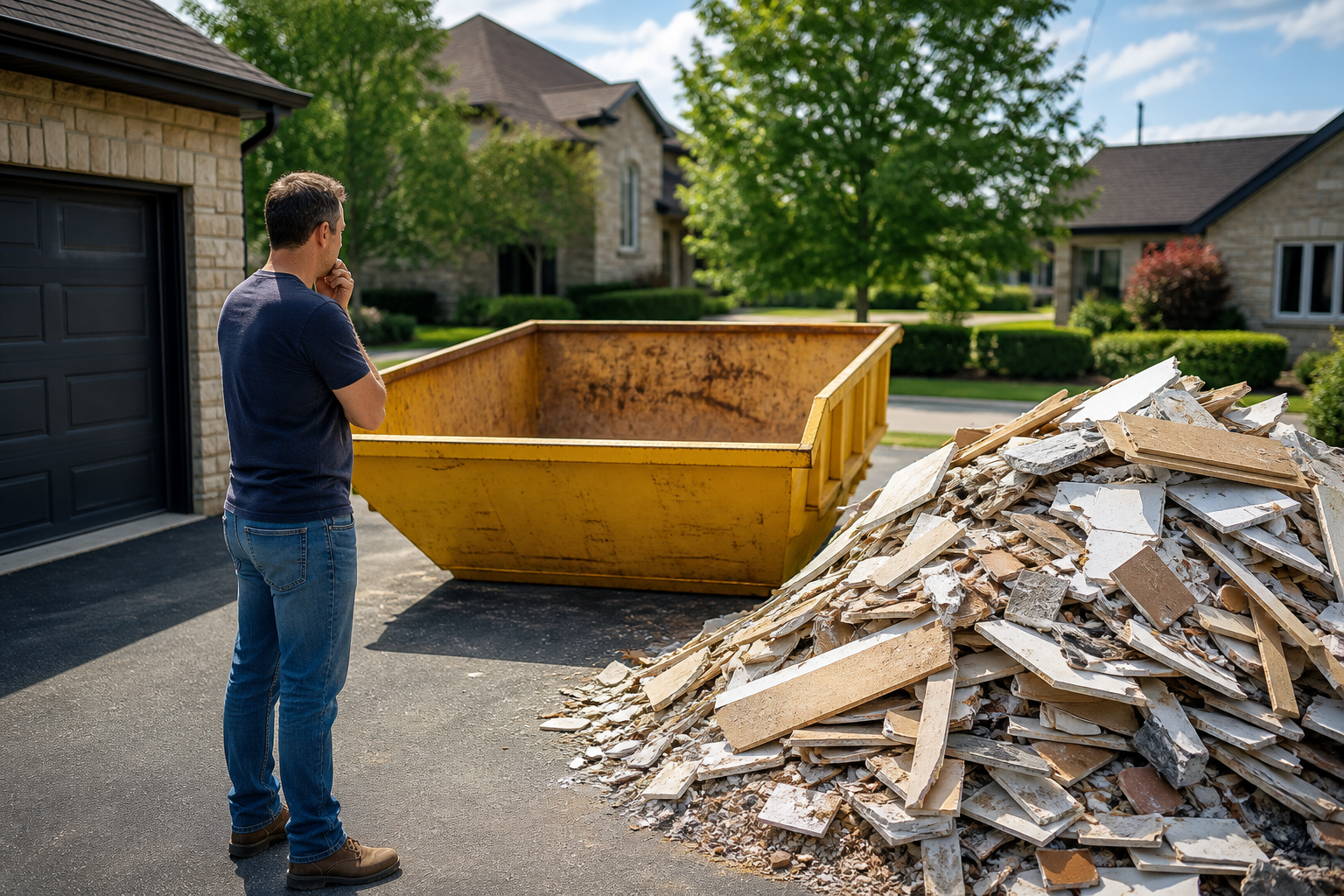
Ever stared at a mountain of rubble and thought, "How much skip do I actually need?" If you get it wrong, you're either staring at an overflowing skip (and a hefty extra charge), or you're waving goodbye to your hard-earned cash as you pay for more empty space than your last house party.
This guide is for anyone who's ever been bamboozled by skip sizes, whether you call it a skip, a skip bin, or just 'that big metal box where all my problems go'. We'll break down the sizes, show you how to measure up your mess, and help you avoid classic mistakes that cost time and money. And if you want the shortcut, our skip size calculator does the legwork for you.
Why Getting Your Skip Size Right Actually Matters
Ordering a skip without a proper estimate is like doing your weekly shop with no list and a blindfold – you'll always end up with too much of something, and not nearly enough of what you actually need. Hiring the wrong skip size can lead to unnecessary costs, project delays, or even issues with waste disposal regulations. Too small and you're shelling out for a second skip or making tip runs all weekend; too big and you're literally hiring fresh air. An undersized skip means extra collections or overfilling (which most providers prohibit), while an oversized one means paying for unused space. Let's get it right.
Skip Sizes Explained: What Actually Fits?
Here's the bit most people get wrong: skip sizes aren't measured by length or width, but by volume—cubic metres (m³) in the UK and Australia, cubic yards (yd³) in the US. Think of it like ordering pints at the pub: it's all about how much you can cram in, not how wide the glass is.
| Skip Size Name | Approx Volume | Typical Use | Dimensions (L x W x H) |
|---|---|---|---|
| Mini Skip | 2 yd³ (1.5 m³) | Small clear-outs | 1.2m x 0.9m x 0.8m (4ft x 3ft x 2.5ft) |
| Midi Skip | 4 yd³ (3 m³) | Kitchen/bathroom rip-outs | 1.8m x 1.2m x 1m (6ft x 4ft x 3.3ft) |
| Builder's Skip | 6–8 yd³ (4.5–6 m³) | Renovation, bulky waste | 3.1m x 1.8m x 1.2m (10ft x 6ft x 4ft) |
| Large Skip | 10–12 yd³ (7.5–9 m³) | House clearances | 3.7m x 1.8m x 1.68m (12ft x 6ft x 5.5ft) |
| Maxi Skip | 14–16 yd³ (11–12 m³) | Major projects | 4.1m x 1.8m x 2m (13.5ft x 6ft x 6.5ft) |
| Roll-On Roll-Off | 20–40 m³ (26–52 yd³) | Commercial, construction, big demolitions | Varies |
Remember: skip sizes are a bit like T-shirt sizes—what counts as 'large' in London might be 'medium' in Manchester. Always check with your skip provider, and never assume a 6-yard skip is the same size everywhere.
What Size Skip Do I Need? (And How Not to Guess)
Bet the merchant never told you this: guessing skip size is like measuring the garden for turf with a bit of string and a half-remembered GCSE. The golden rule? Estimate your waste, then add a bit extra for luck. Nobody has ever finished a job saying they wish they'd bought less space.
The best way is to:
- Pile up your waste (or estimate how many bin bags, rubble sacks, or wheelbarrow loads you'll produce).
- Measure the pile: Length × Width × Height in metres (or feet for our imperial mates).
- Convert to cubic metres/yards:
- For metric: L (m) × W (m) × H (m) = m³
- For imperial: L (ft) × W (ft) × H (ft) ÷ 27 = yd³
- Add 10–20% extra space for odd shapes, air gaps, and those bits you find behind the shed.
Or, skip the maths and punch the numbers into our skip size calculator. It does the sums and even suggests the next size up, because cramming never ends well.
Key Considerations When Choosing Your Skip
- Waste Type: Skip sizes are all about volume, not weight. If you're chucking out dense stuff like hardcore, soil, or concrete, the skip can hit its weight limit long before you fill it to the brim. On the flip side, if you're getting rid of old wardrobes or kitchen units, you'll fill the space before you hit the weight cap. Think of it like trying to fill a suitcase for Ryanair – it's not just about how much you can cram in, but how heavy it is.
- Access and Space: Make sure your chosen skip will fit on site, drive, or road. Larger skips need more room for delivery and collection. A 12 yard (9m³) skip isn't fitting through the garden gate.
- Permits: Placing a skip on a public road usually needs a permit—check with your local authority. If it's on private property (driveway, garden, building site), a permit usually isn't required.
- Weight Restrictions: Especially important for soil, brick, or hardcore loads. Builder's skips (6–8 yd³/4.5–6 m³) are designed for such loads, but always check weight limits with your provider.
- Err on the Larger Side: Most people underestimate waste. It's often cheaper to go one size up than pay for a second skip. If you're on the fence, always go up a size. It's like ordering chips—better too many than too few.
Worked Example: Real Numbers, No Guesses
Let's say you've ripped out an old kitchen and bathroom, and you've got a pile of waste roughly 3m long, 2m wide, and 1m high (10ft x 6.5ft x 3.3ft).
Metric:
- Volume = 3m × 2m × 1m = 6 m³
Imperial:
- Volume = 10ft × 6.5ft × 3.3ft = 214.5 ft³
- 214.5 ft³ ÷ 27 = 7.95 yd³ (call it 8 yd³)
Add 15% for luck: 6 m³ × 1.15 = 6.9 m³ (about 7 m³)
So, you'll want at least an 8-yard (6 m³) builder's skip. If you're on the fence, always go up a size. It's like ordering chips—better too many than too few.
Still not sure? Let the skip size calculator crunch it in seconds.
Another Worked Example: Bedroom Renovation
Scenario: You're gutting a 3m x 4m (10ft x 13ft) bedroom down to bare bones. You've got:
- 10m² (108ft²) of old carpet
- 20 bags of plasterboard (drywall), each 0.1m³ (3.5 cu ft)
- A few bits of broken furniture
Total volume:
- Carpet: 0.8m³ (roughly 1 cu yd)
- Plasterboard: 2m³ (2.6 cu yd)
- Furniture: 1m³ (1.3 cu yd)
Add the lot: 3.8m³ (5 cu yd). Don't forget a bit of breathing space – add 10% for good measure (the spare teabags principle). So you're at about 4.2m³ (5.5 cu yd).
Result? That's bang on for a 4 yard (3m³) midi skip if you're clever with your packing, but you'll thank yourself for bumping up to a 6 yard (5m³) builders' skip. Nobody has ever finished a job saying they wish they'd bought less skip.
How to Measure a Skip Size (And Not Get Caught Out)
You might think measuring a skip is as easy as sizing up your mate's dodgy haircut. But, skip capacity is all about volume, not just footprint.
To check a skip's size:
- Measure the internal length, width, and height in metres (or feet).
- Multiply: L × W × H.
- That gives you volume in m³ (or ft³).
- Convert cubic feet to cubic yards: ft³ ÷ 27 = yd³.
Most UK/AU skips are sold as cubic metres, most US skips as cubic yards. If your supplier's talking in riddles, just run the numbers through the skip size calculator.
Skip Size Cheatsheet: Quick References
- 2 yd³ (1.5 m³) skip: 20–25 bin bags (small projects)
- 4 yd³ (3 m³) skip: 40–45 bin bags (bathroom/kitchen jobs)
- 6–8 yd³ (4.5–6 m³) skip: 60–80 bin bags (builders' standard)
- 12 yd³ (9 m³) skip: 120+ bin bags (major clear-outs)
Buy too small and you'll be making friends with your local tip. Buy too big and you're paying to haul fresh air. Just like Goldilocks, aim for 'just right'—and don't forget the skip size calculator if you don't fancy doing the sums.
Typical Skip Sizes for Popular Projects
| Project Type | Suggested Skip Size (yd³/m³) |
|---|---|
| Garden shed clear-out / tidy-up | 2–4 yd³ (1.5–3 m³) |
| Bathroom/kitchen refurbishment | 4–6 yd³ (3–4.5 m³) |
| Full house clearance | 8–12 yd³ (6–9 m³) |
| Small construction job | 6–8 yd³ (4.5–6 m³) |
| Large building project | 12–16 yd³ (9–12 m³) |
| Major building project / commercial | 20–40 m³ (26–52 yd³) |
Pro Tips to Avoid Skip Hire Headaches
- Don't mix units. Measure your waste in metres (and feet) or cubic yards (and metres), but stay consistent when you book. Ordering in feet but the skip's labelled in metres? That's measuring the room in feet and the timber in metres and hoping for the best.
- Check weight limits. Heavy waste like soil, hardcore, or bricks? You'll often need a smaller skip – or risk the driver refusing collection.
- Always round up. If in doubt, size up. Overfilling a skip is illegal in the UK, Australia, and most US states – and gets you a hefty extra charge. Most companies will refuse collection or charge extra if waste is above the rim.
- Plan where it goes. A 12 yard (9m³) skip isn't fitting through the garden gate. Check access before you order, or you'll be offloading waste by the bucket. Measure your driveway or site entry to ensure the skip lorry can deliver and collect safely.
- Skip contents: Hazardous materials (asbestos, electricals, chemicals) often require specialist disposal. Some providers allow mixed waste, while others require segregation (e.g. general waste, inert waste, plasterboard). Always ask your skip company and follow their guidelines to avoid extra charges.
Questions People Are Actually Asking
What size skip do I need?
It depends on your waste volume, the type of material, and how much room you've got. For most home clear-outs (think shed or garage), a 4 yd³ (3 m³) midi skip is plenty. For renovations or bulky waste, go for a 6–8 yd³ (4.5–6 m³) builder's skip. Measure your pile and always round up to avoid doubling your costs.
What size skip will I need?
If in doubt, estimate your waste (see our worked example), add 10–20% for luck, and use a skip size calculator to match your volume to the nearest skip. It's quicker (and cheaper) than hiring a second skip later.
What size skip?
Mini (2 yd³/1.5 m³) for small jobs, midi (4 yd³/3 m³) for most household projects, builder's skip (6–8 yd³/4.5–6 m³) for renovations, and large/maxi (10–16 yd³/7.5–12 m³) for big clear-outs. Always check dimensions with your skip provider, as sizes can vary.
How to measure a skip size?
Measure the inside length, width, and height of the skip (in metres or feet). Multiply these for volume. Convert to cubic metres (m³) or cubic yards (yd³), depending on your local system. Not sure? The skip size calculator does the conversion for you.
What size skip do I need for a bathroom renovation?
A 4-yard (3 m³) midi skip is usually enough for a standard bathroom refit, including tiles, an old bath, and fittings. For larger bathrooms or extra fixtures, consider a 6-yard (4.5 m³) skip.
Can I put soil and rubble in any skip?
Not every skip is suitable for heavy waste like soil, concrete, or bricks. Builder's skips (6–8 yd³/4.5–6 m³) are designed for such loads, but always check weight limits and local regulations with your provider.
What happens if I overfill my skip?
Overfilling a skip is not allowed. Most companies will refuse collection or charge extra if waste is above the rim. It's safer and cheaper to hire a slightly larger skip than risk additional fees.
How do I estimate how much waste I have?
Start by listing the main items and using their approximate volume. For bags and loose waste, a wheelie bin is about 0.25 m³ (0.33 yd³). For bulky items, measure length × width × height for volume. Or use a handy skip size calculator for extra help.
Do I need a permit for my skip?
If your skip is placed on a public road, pavement, or verge, you'll likely need a local authority permit. If it's on private property (driveway, garden, building site), a permit usually isn't required.
Can I mix different types of waste in one skip?
Some providers allow mixed waste, while others require segregation (e.g. general waste, inert waste, plasterboard). Always ask your skip company and follow their guidelines to avoid extra charges.
How much does skip hire cost?
Prices vary by region, skip size, and hire duration. In the UK, a 6 yd³ (4.5 m³) skip might cost anywhere from £150–£300, while in the US, a 10 yd³ skip could be $250–$500. Always shop around and check what's included (e.g., permits, weight limits). For a tailored quote, ask your local provider.
How much is skip hire per day?
Most companies price per week, not per day, but you can often arrange shorter or longer hires. Expect to pay a base price for the skip (covering up to 7 days), with extra charges for longer periods. Always confirm with your provider to avoid nasty surprises.
How much skip hire near me?
Prices vary by region and availability. Urban areas like London, Dublin, or Sydney will generally be more expensive than small towns. Search for local skip hire companies and compare quotes, or use an online estimator to budget before you call around.
How much skip hire UK? How much skip hire London?
In the UK, especially in London, expect to pay more for both the skip and any necessary permits for on-road placement. Mini skips might start from £90-£120 in cheaper areas, while the same skip in London could be £150 or more. Larger skips rise accordingly. Always clarify the cost upfront, including VAT and any extras.
Conclusion: Don't Skip the Planning
Choosing the right skip size is the difference between a smooth clear-out and a heap of hassle (and over-the-odds charges). Measure your waste honestly, allow for a bit of extra space, and don't get caught short by regional quirks.
Ready to skip the guesswork? Use our skip size calculator to find your perfect match—so you only pay for what you actually need.
Work out your waste in seconds
These calculators help you measure up your project waste and work out exactly which skip size you need.
- Skip Size Calculator — tells you which skip size fits your waste volume so you don't overpay or overflow.
- Excavation Calculator — works out how much soil you're digging out from foundations, trenches or landscaping jobs.
- Volume Calculator — calculates the cubic metres or yards of any awkward-shaped pile of rubble or waste.
Related reading: Skip Volume Calculator — breaks down every skip size with real-world examples of what actually fits inside.
Explore every free calculator on HowMuchDoINeed — no sign-up required.
Explore every free calculator on HowMuchDoINeed — no sign-up required.