
How To Read A Ruler: The No-Nonsense Guide for Anyone Who’s Ever Squinted at a Tiny Line
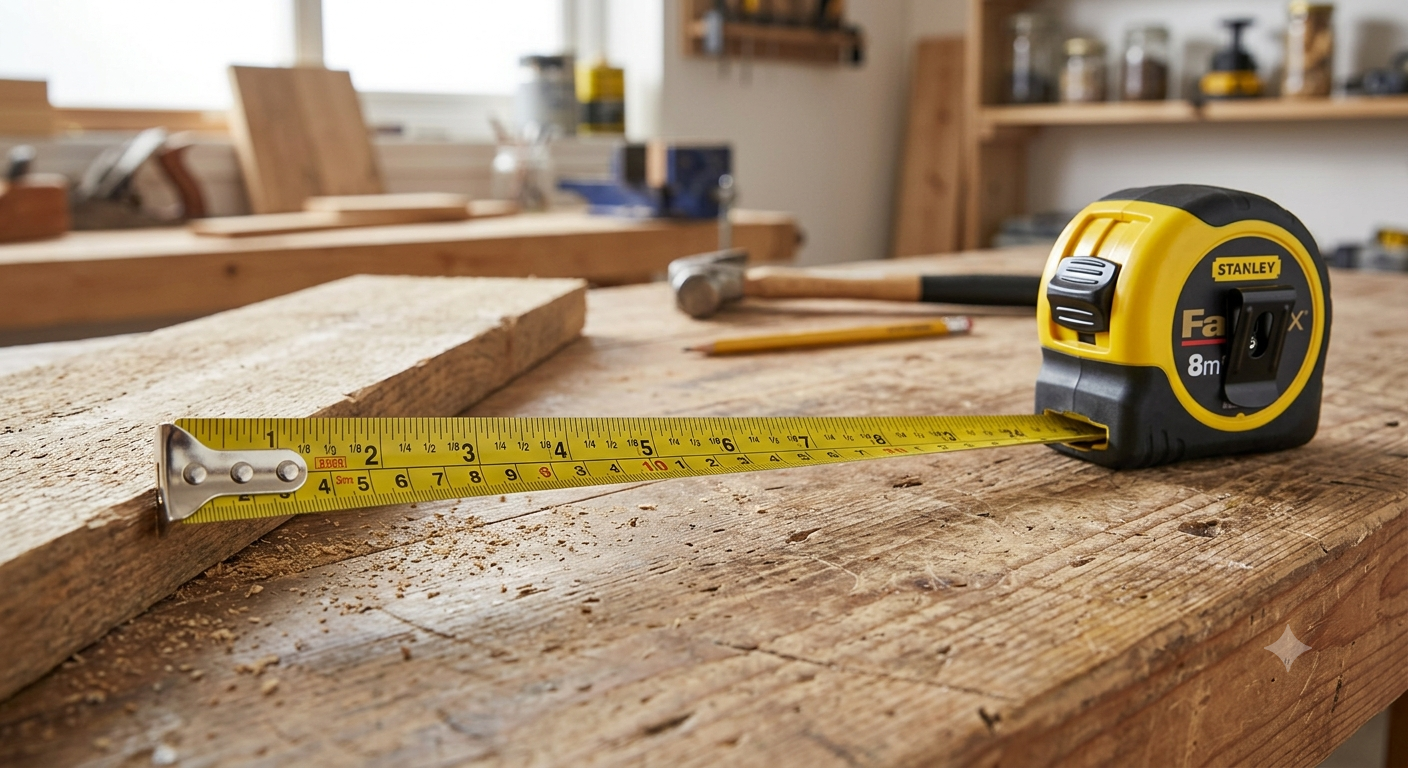
Ever had to measure up for a job, only to realise you’re holding the ruler upside down, squinting at the markings and thinking, “Is this line a quarter, a half, or just wishful thinking?” Don’t worry, you’re not the only one who’s ever faked confidence in front of a tape measure. Today, I’ll walk you through exactly how to read a ruler—whether it’s metric, imperial, or one of those hybrid ones that look like a maths teacher’s fever dream. By the end, you’ll be measuring like a pro, not guessing like you’re doing the pub quiz.
The Two Main Ruler Species: Metric vs Imperial
Let’s start with the basics. Rulers come in two main species:
- Metric (centimetres and millimetres): Used in the UK, Europe, Australia, New Zealand, and most of the world.
- Imperial (inches and feet): Common in the US, parts of Canada, and a few places determined to keep the old ways alive.
Some rulers even have both systems—one on each edge—so you can impress everyone by being bilingual (in measurements, at least).
Ruler Anatomy: What All Those Lines Mean
Here’s the bit most people get wrong: not all lines are created equal. A ruler is basically a tiny city skyline—all those short and tall lines have a job.
On a Metric Ruler (Centimetres and Millimetres)
- Long lines: Mark each centimetre (cm). There are 10mm in every cm.
- Shorter lines: Each one is a millimetre (mm). If you’re counting tiny lines, you’re in millimetres.
On an Imperial Ruler (Inches and Fractions)
- Biggest lines: Each whole inch (in).
- Medium, small, and even smaller lines: Break the inch into halves (1/2), quarters (1/4), eighths (1/8), and sometimes even sixteenths (1/16) or thirty-seconds (1/32). It’s like slicing a pie into smaller and smaller wedges—ideal for perfectionists and people who like a challenge.
How To Read a Ruler in Metric (Centimetres and Millimetres)
Let’s break it down. Imagine you’ve got a ruler marked up to 30cm (12in) with millimetres too.
Steps:
- Start at zero (none of this “let’s guess where the end starts” nonsense).
- Count the number of full centimetre lines from zero to your measurement.
- Each little line between is a millimetre. Ten of these make up each cm.
- So, if your measurement lands on the 7th tiny line past 12, that’s 12cm + 7mm = 12.7cm.
Worked Example:
- You measure a board, and the edge lines up with the 18th big line and 3 little lines past it.
- That’s 18cm + 3mm = 18.3cm (7 1/5in).
Pro tip:
- Metric is a doddle for decimals. 18.3cm = 183mm if you need the small numbers.
How To Read a Ruler in Imperial (Inches and Fractions)
Here’s where the fun begins—or the headaches, if you’re not careful. Each inch gets chopped into smaller bits: halves, quarters, eighths, and so on. It’s like a family tree where everyone’s called "inch" but with different nicknames.
Steps:
- Start at zero (don’t measure from the end if the ruler’s battered—start from the first marking).
- Count the number of big lines (inches).
- Work out which little line your measurement lands on. Each one will be a fraction of an inch, depending on how many marks per inch:
- If there are 16 marks per inch, each is 1/16th of an inch.
- 8 marks? Each is 1/8th. Easy maths (ish).
Worked Example:
- You measure a shelf, and it lands on the 7th small line after the 9in mark, with 16 little lines per inch.
- That’s 9 inches + 7/16 inches = 9 7/16in (239.7mm or 23.97cm).
Analogy time:
- Reading fractions on a ruler without counting is like trying to guess how many sugars in your tea by staring at the mug—count the lines, don’t guess.
Reading Decimals and Converting Between Systems
Don’t panic if someone throws a decimal at you: “Cut me a piece 6.35cm (2.5in) long.”
- 1cm = 10mm (or 0.39in)
- 1in = 2.54cm (or 25.4mm)
To convert:
- Centimetres to inches: cm ÷ 2.54 = inches
- Inches to centimetres: in × 2.54 = cm
Example:
- 15cm × 2.54 = 38.1cm (wait, that’s not right—see, always check units!)
- Properly: 15cm ÷ 2.54 = 5.91in
- 6in × 2.54 = 15.24cm
Fractions vs Decimals: Which Is Which?
Bet the merchant never told you this: fractions are for rulers, decimals are for calculators (and engineers who like to make things complicated).
- 1/2 inch = 0.5in
- 1/4 inch = 0.25in
- 3/4 inch = 0.75in
If you need to convert fractions to decimals, just divide the top by the bottom (numerator by denominator).
| Fraction | Decimal | Millimetres (mm) | Centimetres (cm) |
|---|---|---|---|
| 1/2 | 0.5 | 12.7 | 1.27 |
| 1/4 | 0.25 | 6.35 | 0.635 |
| 3/4 | 0.75 | 19.05 | 1.905 |
Reading a Ruler in Feet and Inches
Some jobs want measurements in feet and inches (e.g. 6ft 3in or 1.9m). Remember:
- 1ft = 12in (30.48cm)
- To measure: count the number of 12in sections for each foot, then the extra inches.
Example: If your plank is 3ft 4in (1.02m), that’s 3 × 12 = 36in + 4in = 40in (101.6cm).
Tips for Reading a Ruler Correctly (So You Only Cut Once)
- Always start from zero, not the battered end of the stick.
- Double-check if you’re reading inches or centimetres—measuring a room in inches when you need metres is a quick way to order too much carpet.
- If in doubt, measure twice, cut once. Nobody has ever wished they’d made more mistakes.
- For tiny measurements, use the metric side. For old-school woodworking, imperial can be handier.
Questions people are actually asking
How to read a ruler?
To read a ruler, first check if it’s metric (centimetres/millimetres) or imperial (inches/fractions). Start from zero, count the big lines for whole units, and the small lines for fractions (imperial) or millimetres (metric). Add them together for your measurement.
How to read a ruler in inches?
Look for the big numbered lines (inches). Count those, then see how many smaller lines past that point—each usually represents a fraction (like 1/8 or 1/16) of an inch. Example: 4 big lines and 3 smaller lines on a 1/16 scale = 4 3/16 inches.
How to read a ruler in cm?
Count the big lines (centimetres), then add the smaller lines (millimetres). 1cm = 10mm, so 5 big lines and 6 small lines = 5.6cm.
How to read a ruler in mm?
Every small line is 1mm. Count from zero to your mark. If it’s 37 small lines, it’s 37mm (3.7cm or 1.46in).
How to read a ruler in feet and inches?
Count the number of feet (1ft = 12in), then the extra inches. For example, 2ft 5in is 29in (73.7cm). Some tape measures will mark feet and inches separately.
How to read a ruler in decimals?
Each millimetre on a metric ruler is 0.1cm. On an imperial ruler, convert the fraction to decimal (e.g. 1/4in = 0.25in). Use a calculator if you want to be sure.
How to read a ruler in fractions?
On an imperial ruler, the small lines are usually halves, quarters, eighths, or sixteenths of an inch. Count how many little lines past the inch, then write it as a fraction (e.g. 7 little lines on a 1/16 ruler = 7/16in).
Conclusion: Measure Like You Mean It
There you go: ruler reading, demystified. No more guessing, no more “close enough”. Whether you’re measuring for shelves, garden beds, or working out if you can squeeze another biscuit tin in the cupboard, you’re sorted. If you want to take it up a notch, use a calculator to convert between units or check your take-off. Happy measuring—and remember, measuring with confidence is like having a spare teabag: you’ll never be caught short.
Free tools to put this into practice
Reading is one thing — working out your own numbers is what saves time and money. Here are the free HowMuchDoINeed calculators that pair best with this guide:
- Browse all calculators — find the right calculator for your project and get instant quantities and costs.
Explore every free calculator on HowMuchDoINeed — no sign-up required.