
Concrete Stairs Calculator: Nail Your Pour First Time (No Dodgy Guesstimates Required)
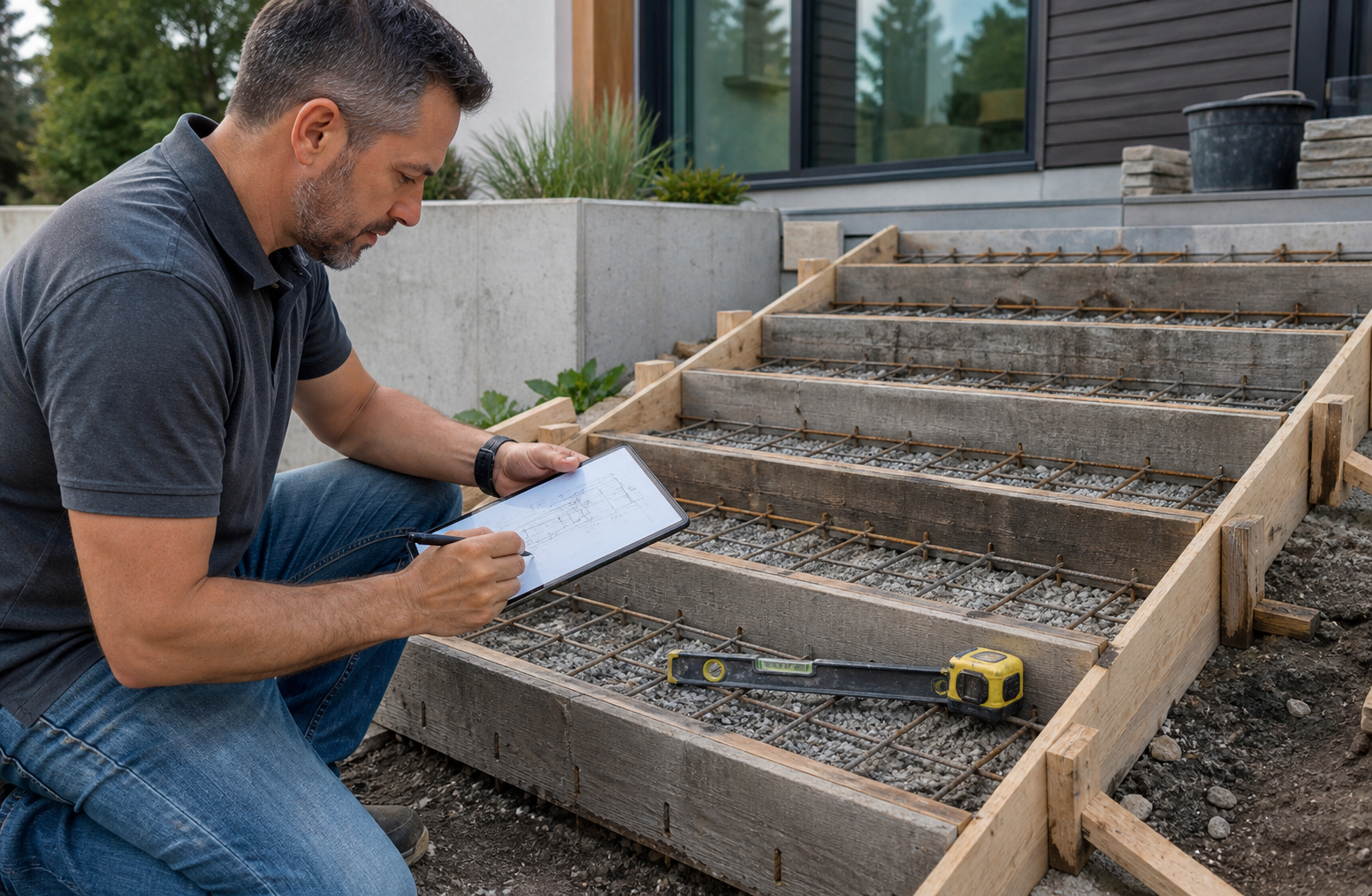
Ever got halfway through pouring concrete stairs (steps) and realised you’re a couple of bags short—or worse, a wheelbarrow too much? Ordering concrete without a proper calculation is like making tea for the whole site with one teabag. Not smart, and guaranteed to leave someone grumbling.
Let’s walk you through exactly how to estimate concrete for stairs (whether you call them steps or stairs, you’ll get the right answer here), avoid the classic traps, and use a concrete stairs calculator to take the guesswork out for good.
Why Bother Calculating Concrete for Stairs Properly?
Here’s the bit most people get wrong: stairs aren’t just a box you fill up. They’re a series of rises (the vertical bits) and treads (the flat bits). Miscalculate by even a few centimetres (or inches) per step and you’ll either be scrabbling for extra mix or paying for a skip to cart away the surplus.
It’s a bit like measuring the garden in metres and ordering turf in square yards, and hoping it’ll work itself out. Spoiler: it won’t.
The right calculation means:
- No last-minute dashes to the builder’s merchant
- No awkward leftover piles of concrete setting behind your shed
- A finish you’re actually proud of (and safe to walk on)
How To Work Out Concrete Volume for Stairs (Steps)
Let’s not sugar-coat it: stairs are fiddly shapes. You’re basically pouring a zig-zagging wedge. But there’s a simple way to break it down. Think of your stairs as a series of right-angled triangles stacked on top of each other, then multiply by the width. Easy as pouring a slab—once you know the trick.
The Basic Formula
For a straight flight of stairs:
- Work out the total rise (height) and run (horizontal length) of your staircase.
- Count the number of steps.
- Calculate the volume of the triangular profile:
- Volume = (Total Rise x Total Run x Width) / 2
- That’s your stair-shaped wedge.
- Add for landings if needed (treat as a simple slab: length x width x thickness).
- Allow for wastage: Add 10% to your total. It’s the spare teabags of concrete jobs. You’ll thank yourself later.
Units: Metric & Imperial
- Metric: Use metres (m), centimetres (cm), and millimetres (mm)
- Imperial: Use feet (ft) and inches (in)
Just don’t mix and match, or you’ll be explaining to your client why their steps look like a Picasso painting.
Concrete Stairs Calculator: How To Use It
Punching numbers into a concrete stairs calculator saves you the trouble of scribbling triangles on the back of a plasterboard (drywall) offcut. Input your stair dimensions—total rise, total run, width, and number of steps—and let the tool spit out your exact volume. Most calculators will give you both cubic metres (m³) and cubic yards (yd³), so you can buy in either bags or by the truckload.
Want to skip the maths? Try the concrete stairs/steps volume calculator here and see just how little time it actually takes.
Worked Example: Metric & Imperial
Let’s say you’re building a garden set of concrete steps (stairs) with these specs:
- Total rise: 0.9m (3ft)
- Total run: 2.4m (8ft)
- Width: 1.2m (4ft)
Step 1: Calculate the triangular wedge volume:
- Volume = (0.9m x 2.4m x 1.2m) / 2 = (2.592m³) / 2 = 1.296m³
- Add 10% wastage: 1.296m³ x 1.1 = 1.425m³
In imperial:
- Volume = (3ft x 8ft x 4ft) / 2 = (96ft³) / 2 = 48ft³
- Add 10% wastage: 48ft³ x 1.1 = 52.8ft³
Conversion:
- 1m³ ≈ 1.31yd³
- 1.425m³ ≈ 1.87yd³
So, for this set of stairs, you’d order just under 1.5 cubic metres (2 cubic yards) of concrete. Not bad, and certainly better than guessing and being a barrow short.
What About Landings, Flights and Winder Steps?
Bet the merchant never told you this: if your stairs have a landing, calculate its volume separately (treat it like a slab). For winder steps (the ones that turn a corner), you’ll need to break each triangular step into smaller chunks or use the calculator’s advanced mode.
And this is why calculators like the concrete stair stringer volume tool are your best mate—they won’t let you forget anything.
Don’t Forget: Concrete Strength & Mix
Not all concrete is created equal. For steps that are going to see a lot of footfall (or, let’s be honest, the odd dropped wheelbarrow), you want at least a C25/30 (3,625 psi) mix for UK jobs, or a 4,000 psi mix if you’re in the US. Ask your supplier for "stair-grade" or "structural" if you’re not sure.
Questions People Are Actually Asking
How much do concrete stairs cost?
Costs vary like the British weather. For a basic straight run of stairs (steps), expect to pay for materials, labour, and any formwork. Material costs depend on your local concrete price per cubic metre (or yard), but always add 10% for wastage. Labour and finish will bump the total. For a typical set of garden steps, you might budget anywhere from a few hundred to a few thousand (pick your currency), depending on size and finish.
How much do concrete steps cost?
"Steps" and "stairs" are interchangeable here. See above for the basics, but remember: the more complex the shape (winder steps, landings, curves), the more you’ll pay. Precast steps can be cheaper per step but might need special delivery or craning in.
How much concrete do I need for steps?
Use the formula above, or save time and plug your measurements into the concrete steps volume calculator. Always round up and allow for a 10% wastage buffer.
How much does it cost to pour concrete stairs?
You’ll be paying for:
- Concrete (by the cubic metre/yard)
- Formwork materials (timber/lumber, nails, screws)
- Labour (unless you’re DIYing)
- Finishing (trowelling, edging, nosings)
Ask for a breakdown from your contractor or supplier. Don’t forget VAT/GST or delivery charges.
How much are precast concrete stairs?
Precast steps are poured in a factory and delivered ready to drop in. They can be cheaper for short runs but pricier for custom shapes. You’ll also need to factor in delivery, lifting equipment, and installation.
How much to repair concrete stairs?
Repairs depend on the scale: patching cracks is cheap and cheerful, but full structural repairs or resurfacing can be a bigger job. Get a few quotes if it’s more than skin-deep.
How much to fix concrete stairs?
See above—fixing and repairing are much the same. Minor chips and cracks are a DIY job with a repair kit. Major movement or collapse means calling in the pros.
Conclusion: Don’t Guess—Calculate and Pour With Confidence
Nobody ever finished a set of steps wishing they’d ordered less concrete. Get your take-off right, allow for a bit extra, and use the concrete stairs calculator to take the stress out of your next pour. Your future self (and your back) will thank you.
Free tools to put this into practice
Reading is one thing — working out your own numbers is what saves time and money. Here are the free HowMuchDoINeed calculators that pair best with this guide:
- Concrete Cube Calculator Guide — work out exactly how much you need and what it will cost.
- Stair Stringer Calculator — get an instant materials estimate for your project.
- Concrete Post Calculator — size up quantities and costs before you head to the merchant.
- Concrete Weight Calculator — plan your order so you avoid over- or under-buying.
Explore every free calculator on HowMuchDoINeed — no sign-up required.